
Views: 0 Author: Site Editor Publish Time: 2026-09-27 Origin: Site


When a battery project calls for a 60Ah, 70Ah, or 80Ah pouch cell, capacity is usually the first number people compare.
It should not be the last.
Two NMC pouch cells with similar capacities can behave very differently once they are installed in a battery module. Their dimensions may require completely different module structures. Their current capability may suit different applications. Tab position, cooling, compression, cell consistency, and available documentation can also determine whether a cell is practical for a real project.
This is especially important in the 60–80Ah range. These cells are widely used in EV battery modules, vehicle battery upgrades, industrial battery packs, electric motorcycles, specialty vehicles, and other applications where both energy density and available space matter.
So how should you choose?
The best starting point is not simply asking, “Which cell has the highest Ah?”
A better question is:
Which cell fits the electrical, mechanical, thermal, and supply requirements of the complete battery system?
Why 60–80Ah NMC Pouch Cells Are Common in EV Projects
Large-format NMC pouch cells offer a useful combination of energy density, relatively low weight, and packaging flexibility.
Compared with cylindrical cells, fewer large pouch cells may be required to build a high-capacity battery pack. Compared with conventional rigid prismatic cells, the laminated pouch structure can also give engineers more freedom when working with a restricted battery enclosure.
This makes the 60–80Ah range particularly interesting for projects such as:
EV and light-EV battery modules
replacement or upgrade batteries for existing vehicles
electric motorcycles and utility vehicles
AGVs and mobile industrial equipment
high-energy custom battery packs
prototype and low-volume vehicle projects
However, pouch cells require careful mechanical integration. They should not simply be stacked inside an enclosure and connected together.
The cell is only one part of the finished battery system.
Before comparing individual cell models, define the pack architecture.
Suppose a project requires approximately 350V nominal voltage. With an NMC cell operating around the typical 3.6–3.7V nominal range, the battery may require roughly 95 cells in series, depending on the exact operating voltage window.
If the selected cell is around 70Ah and the design uses one cell in parallel, the resulting battery will also be approximately 70Ah.
That sounds simple, but changing from a 60Ah cell to a 77Ah cell affects far more than capacity. It changes:
total pack energy
cell weight
module dimensions
heat generation under load
required current per cell
vehicle range or operating time
pack cost
available installation space
This is why it is useful to define the target system first and select the cell second.
For replacement battery projects, dimensions are often the first real limitation.
An original battery enclosure may have fixed module dimensions, fixed mounting points, cooling plates, busbar locations, and service clearances. A cell with excellent electrical performance is of little value if it cannot be integrated safely into the available space.
For every pouch cell under consideration, check at least:
Thickness × width × height, together with tab dimensions and tab orientation.
Do not compare the cell body alone. Depending on the design, you may also need space for:
compression plates
insulation sheets
busbars or flexible connectors
temperature sensors
cooling plates
module frames
wiring and BMS connections
A few millimeters of difference per cell can become significant when dozens of cells are stacked into one battery pack.
For projects where space is very restricted, selecting the correct cell geometry can be more important than gaining another 3–5Ah of nominal capacity.
Consider three cells rated around 60Ah, 70Ah, and 77Ah.
It is tempting to assume that the 77Ah option is automatically the best because it stores more energy.
That may be true for some applications, but not for all of them.
A 60Ah cell with suitable high-current capability may be a better fit for a performance-oriented vehicle. A 70–76Ah cell may offer a better balance between energy, dimensions, and available module space. A larger 77Ah-class cell may be attractive when maximizing total pack energy is the main objective.
The correct choice depends on what the battery actually has to do.
Discharge-rate figures deserve careful attention.
A cell may have separate ratings for continuous discharge, short-duration peak discharge, and pulse discharge. These values should never be treated as interchangeable.
For example, a vehicle may only draw its maximum current during hard acceleration, while normal driving requires much less current. An industrial battery, by contrast, may operate at a relatively high load for long periods.
That difference affects cell selection.
For projects where power output is a priority, the SK 3.7V 60.3Ah NMC pouch cell is one option worth evaluating. Its product positioning is more power-oriented than many conventional energy-focused large pouch cells.
For applications with more moderate current requirements, the decision may instead favor energy capacity, mechanical fit, cycle requirements, or cost.
Always confirm the actual continuous and peak current requirements of the complete pack before finalizing the cell.
One common mistake in battery sourcing is trying to find a cell that is “best” at everything.
In practice, cells are developed around different priorities.
A high-power cell may sacrifice some energy density or cost efficiency to support higher current. An energy-oriented cell may be optimized for capacity and runtime rather than very high discharge rates.
For example, Misen also supplies an SK 66.5Ah NCM pouch cell for projects where engineers may place greater emphasis on stable battery-pack integration and long-term operation rather than extreme power output.
Neither approach is automatically better.
For an EV conversion, the correct question is whether the cell can safely handle the expected continuous driving current and acceleration peaks. For an industrial battery pack, duty cycle may matter more. For a stationary or backup system, high peak current may barely influence the design at all.
For some projects, engineers prefer cell formats that have already been associated with automotive or mobility applications.
The LG E63 / E63B 60–63Ah NMC pouch cell falls into this category and can be considered for EV, vehicle battery, RV, and custom battery-pack projects where its mechanical format matches the design.
Moving further up the capacity range, Farasis also offers several large-format NMC pouch cells.
The Farasis P73D 73Ah pouch cell provides another option around the low-70Ah range.
For projects requiring slightly more capacity, the Farasis P76D 76Ah NMC pouch cell can also be evaluated.
The important point is that moving from 63Ah to 73Ah or 76Ah should not be treated as a simple capacity upgrade. Engineers need to check whether the new cell dimensions, tabs, compression requirements, operating voltage range, current capability, and cooling arrangement are compatible with the existing system.
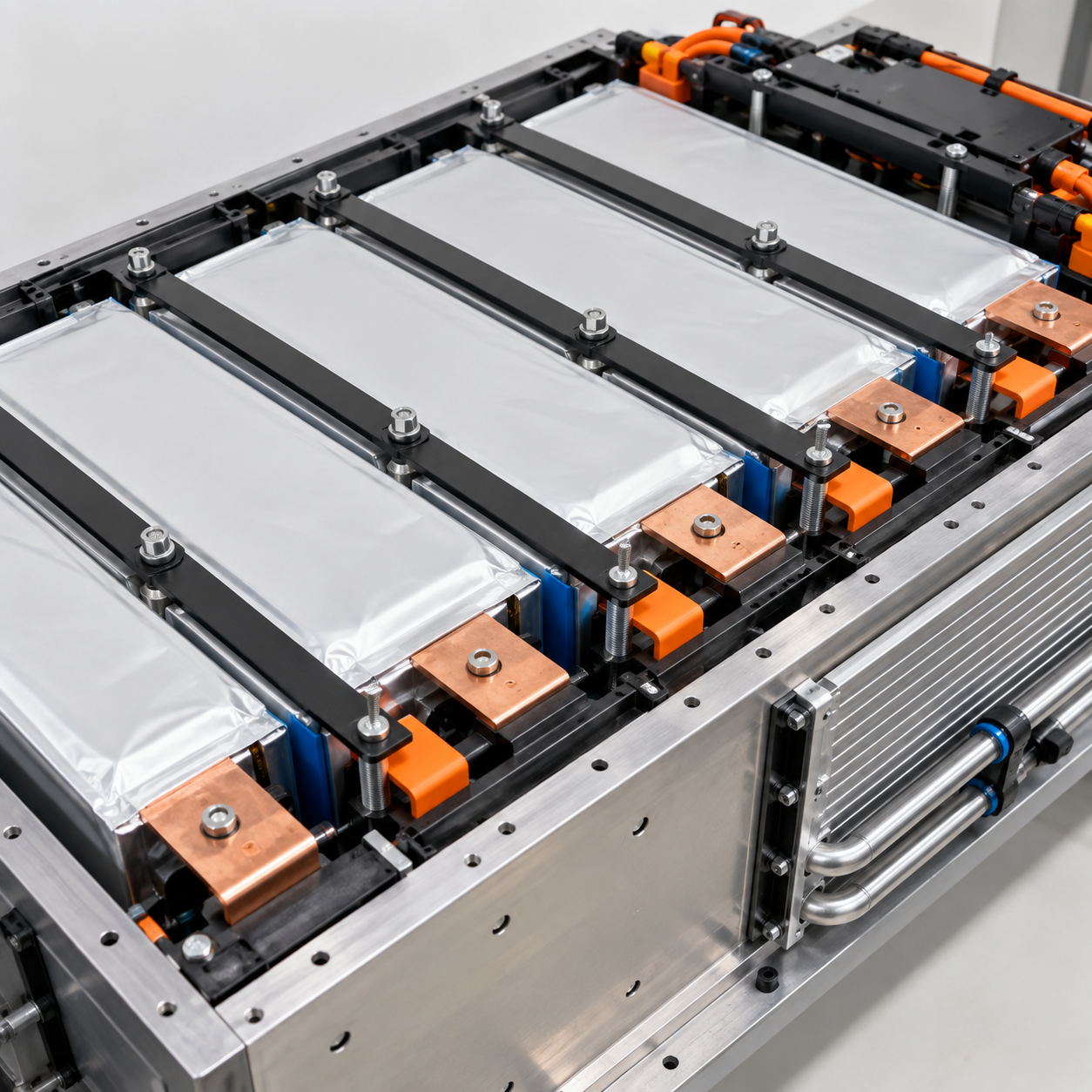
For projects where the objective is to maximize energy within a pouch-cell architecture, cells approaching 80Ah may be attractive.
One example is the SK Innovation E777 77.7Ah NMC pouch cell.
A higher-capacity cell can reduce the need for parallel groups in some designs and can increase total energy without changing the number of cells connected in series.
But again, capacity alone does not determine whether the upgrade is practical.
A physically longer or wider pouch cell may require a completely different module. Increasing capacity can also change the thermal behavior, weight distribution, cooling requirements, and mechanical structure of the finished battery.
For a new battery design, these changes can usually be accommodated during engineering.
For a replacement project using an existing enclosure, they may become the main obstacle.
The following overview shows how these cell families can fit into different project directions.
| Cell | Capacity Class | Typical Project Direction | Main Point to Check |
|---|---|---|---|
| SK 60.3Ah | ~60Ah | Higher-power EV and battery applications | Continuous and peak current requirements |
| LG E63 / E63B | 60–63Ah class | EV, mobility and replacement battery projects | Dimensions and module compatibility |
| SK 66.5Ah | ~66Ah | General battery-pack and industrial integration | Operating current and mechanical design |
| Farasis P73D | 73Ah | EV and larger custom battery packs | Available module space |
| Farasis P76D | 76Ah | Higher-energy EV and battery modules | Mechanical fit and thermal design |
| SK Innovation E777 | ~77.7Ah class | High-energy EV and custom pack projects | Cell geometry and pack layout |
This table should be treated as a starting point rather than a final engineering decision. Exact cell specifications should always be confirmed for the production batch before the module structure is finalized.
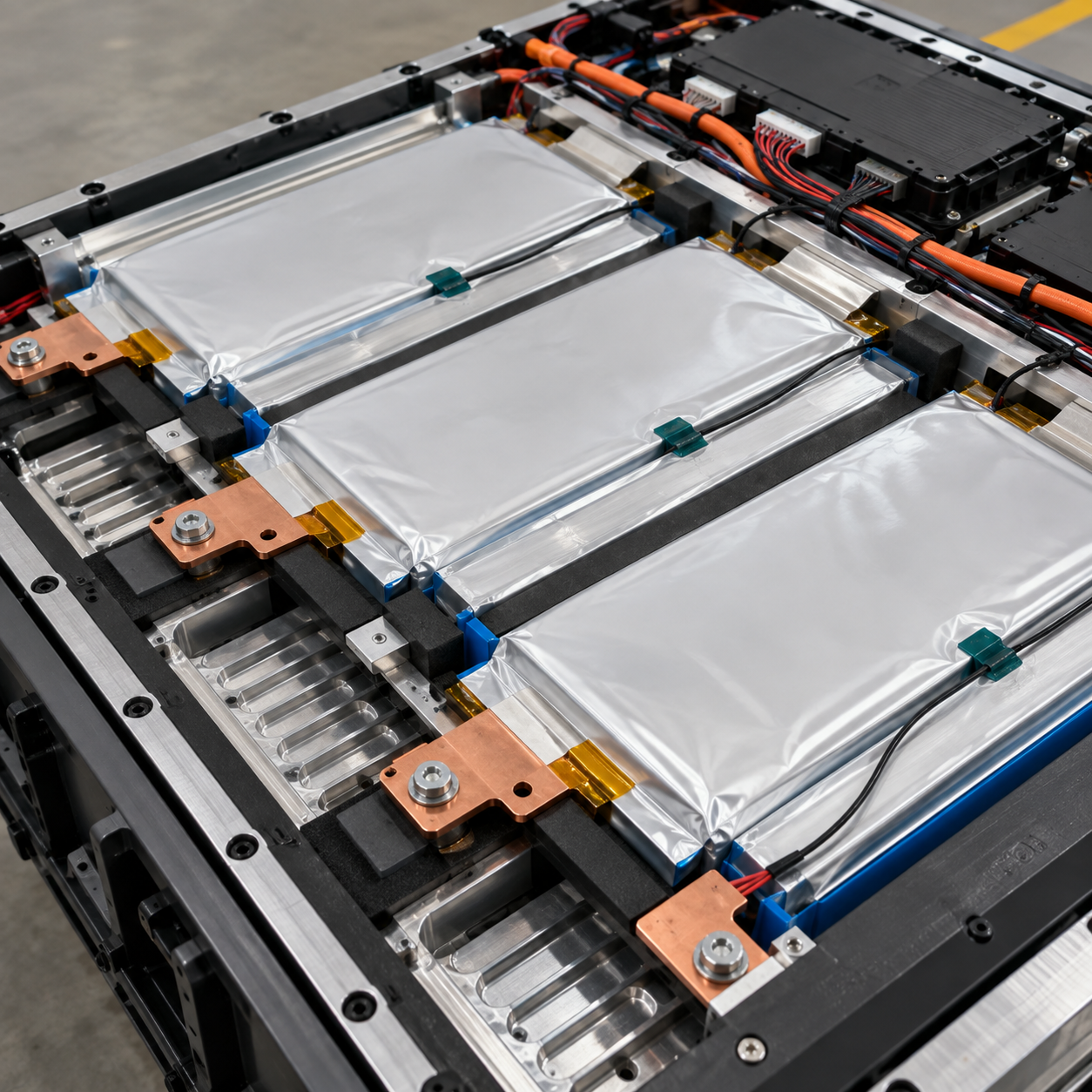
Unlike rigid metal-cased prismatic cells, pouch cells depend heavily on the module structure for mechanical protection.
A good pouch-cell module normally provides controlled support across the large cell surface.
Too little restraint may allow excessive swelling or movement. Excessive compression can also be harmful.
The structure therefore needs to consider compression plates, cell spacing, insulation, thermal expansion, vibration, and long-term dimensional change.
This becomes particularly important in automotive applications because the battery is exposed to vibration, repeated temperature changes, acceleration forces, and thousands of charge and discharge cycles.
A properly selected cell can still perform poorly if the module around it is badly designed.
The cooling requirement of a 70Ah pouch cell cannot be determined from capacity alone.
Heat generation depends strongly on internal resistance, current, duty cycle, ambient temperature, and the thermal path between the cell and cooling system.
A battery for a low-speed utility vehicle may operate comfortably with a relatively simple thermal design. A performance EV or high-current industrial machine may require much more active thermal management.
Before selecting the final cell, it helps to know:
normal continuous current
maximum current and duration
charging current
expected ambient temperature
available cooling method
maximum acceptable cell temperature
These figures give the battery engineer much more useful information than capacity alone.
A single pouch cell may perform perfectly on a test bench while the complete battery pack performs poorly.
Why?
Because a battery pack is limited by differences between cells.
Voltage, capacity, internal resistance, self-discharge, and state of charge should remain reasonably consistent across the group. If one cell reaches the upper or lower voltage limit earlier than the others, the BMS may have to stop charging or discharging even though most of the pack still has usable capacity.
This is why cell matching is especially important for large EV battery packs.
For project orders, buyers should discuss testing and matching requirements with the supplier before shipment rather than focusing only on the unit price.
Replacing an existing EV battery cell with a higher-capacity pouch cell can be attractive because the original vehicle may gain additional range without completely redesigning the drivetrain.
But it should not be treated as a plug-and-play change simply because the nominal voltage is similar.
The engineering team should confirm:
Mechanical compatibility. Can the new cell and module fit safely in the original battery enclosure?
Voltage window. Are the charge and discharge limits compatible with the existing BMS and charger?
Current capability. Can the new cells handle the vehicle's continuous and peak current?
BMS behavior. Will the existing BMS work correctly with the new usable capacity and cell characteristics?
Thermal management. Does the original cooling system still provide adequate temperature control?
Connection design. Do the tab dimensions and positions work with the proposed busbars or adapters?
In many conversion projects, these details matter more than the difference between 73Ah and 76Ah.
Cell selection is usually easier when developing a completely new battery pack.
With a new design, engineers can build the enclosure, compression system, busbars, cooling structure, and BMS around the selected cell.
Replacement projects work in the opposite direction.
The cell has to fit an existing mechanical and electrical environment.
That means the selection priorities often differ:
For a new battery pack, start with energy, power, system voltage, expected lifetime, cost, and overall packaging efficiency.
For an existing EV battery replacement, start with dimensions, voltage compatibility, tab structure, current capability, and available space. Capacity comes after those basic compatibility checks.
A supplier can recommend a much more suitable pouch cell if the project requirements are clear.
Instead of sending only:
“Need 70Ah NMC pouch cell.”
Provide the basic system information:
Required nominal cell capacity or acceptable range
Target pack voltage and capacity
Continuous and peak pack current
Maximum available cell or module dimensions
Quantity of cells required
New battery design or replacement project
Cooling method, if already defined
Target application and operating environment
For a replacement project, photos and dimensions of the original cell and battery module are also extremely useful.
With this information, several unsuitable cells can often be eliminated immediately.
There is no single correct answer for every project.
A 60Ah-class cell may be the right choice when high current or an existing module format is the main constraint. A 66Ah cell may offer a useful middle ground. A 73Ah or 76Ah cell may provide additional energy while remaining suitable for a compact EV module. A 77–80Ah-class cell may be attractive when maximizing pack energy is the priority.
The final decision should balance four areas:
Electrical requirements: voltage, capacity, continuous current and peak current.
Mechanical requirements: dimensions, tabs, module structure and available space.
Thermal requirements: operating current, cooling method and temperature limits.
Supply requirements: cell condition, consistency, documentation, available quantity and future supply.
Ignoring any one of these areas can turn an apparently good cell into an expensive engineering problem.
Misen works with a range of large-format NMC pouch cells for EV, mobility, industrial, replacement-battery, and custom battery-pack projects.
Rather than selecting a cell only from the requested Ah rating, our team can help compare available options according to the actual application, including cell dimensions, target voltage, discharge current, module layout, quantity, and integration requirements.
For projects using 60–80Ah NMC pouch cells, send us your required cell dimensions, target capacity, continuous and peak current, quantity, and application.
If you are replacing an existing battery, you can also provide the original cell model, dimensions, photos, and pack configuration.
This usually makes it much easier to identify which pouch-cell options deserve further testing before the battery design is finalized.
Need help selecting a 60–80Ah NMC pouch cell for your EV or battery pack? Contact Misen with your electrical and mechanical requirements, and we can help you compare suitable cell options for your project.


