LiFePO4 Pouch Cells for ESS
Energy storage systems (ESS) are designed around a specific power profile, usable energy target, operating environment and service-life expectation. LiFePO4 pouch cells can be considered for these projects when their electrical ratings and flexible flat format match the module design. The important step is to select the cell and engineer the complete battery system together.
Quick answer LiFePO4 pouch cells are worth evaluating for residential, commercial and industrial ESS where a 3.2V cell platform, long-cycle operating strategy and customized module geometry fit the project. Start with required kW and kWh, calculate the series-parallel configuration, then verify continuous current, charging limits, temperature derating, compression, thermal management and BMS compatibility against the exact cell documentation.
1. Where Do LiFePO4 Pouch Cells Fit in ESS?
LiFePO4 (LFP) is widely used in stationary storage because phosphate cathode chemistry offers favorable thermal stability and strong cycle-life potential when operated within the manufacturer's limits. A pouch format adds a flat, lightweight laminated enclosure that can give battery designers more freedom when arranging cells inside a custom module.
Typical ESS project types include:
Residential solar storage: store surplus PV energy for evening use or backup loads.
Commercial and industrial storage: support peak shaving, load shifting, solar self-consumption and selected backup circuits.
Microgrids and off-grid systems: balance variable renewable generation with local demand.
Telecom and industrial backup: provide standby energy where footprint, service access and predictable discharge behavior matter.
Not every ESS requires a pouch cell. Standard prismatic formats may be preferable where a rigid case, standardized rack design or established supply platform is the priority. Pouch cells are most relevant when their dimensions, tab layout, weight or integration flexibility create a practical system-level advantage.
2. Define the ESS Requirement Before Choosing Cell Capacity
Cell selection should begin with the duty cycle—not with the largest amp-hour number in a catalogue. Two ESS projects with the same energy target may need different cells if one operates at a low, steady discharge rate while the other must handle short power peaks.
| Design input | What to define | Why it matters |
| Power requirement | Continuous and peak power in kW | Determines current demand, busbar sizing and protection coordination. |
| Energy requirement | Required usable energy in kWh | Sets the starting point for cell count and pack capacity. |
| Discharge duration | Target runtime at the expected load | Separates short-duration high-power storage from longer-duration energy storage. |
| Operating window | Minimum/maximum temperature and SOC range | Cell current limits and available capacity can change with temperature and SOC. |
| Service target | Daily cycles, calendar life and maintenance plan | Helps compare cycle-life data and total lifetime cost. |
Remember the difference between power and energy. A 10kW system describes the rate at which energy can be delivered; a 40kWh system describes the nominal amount of stored energy. If the target is 10kW for four hours, the load requires 40kWh of delivered energy before inverter losses, reserve capacity and other system allowances are included.
3. Calculate Nominal Energy and Series-Parallel Configuration
A typical LiFePO4 pouch cell has a nominal voltage of approximately 3.2V. Use the exact voltage and capacity shown in the selected model's documentation when estimating energy:
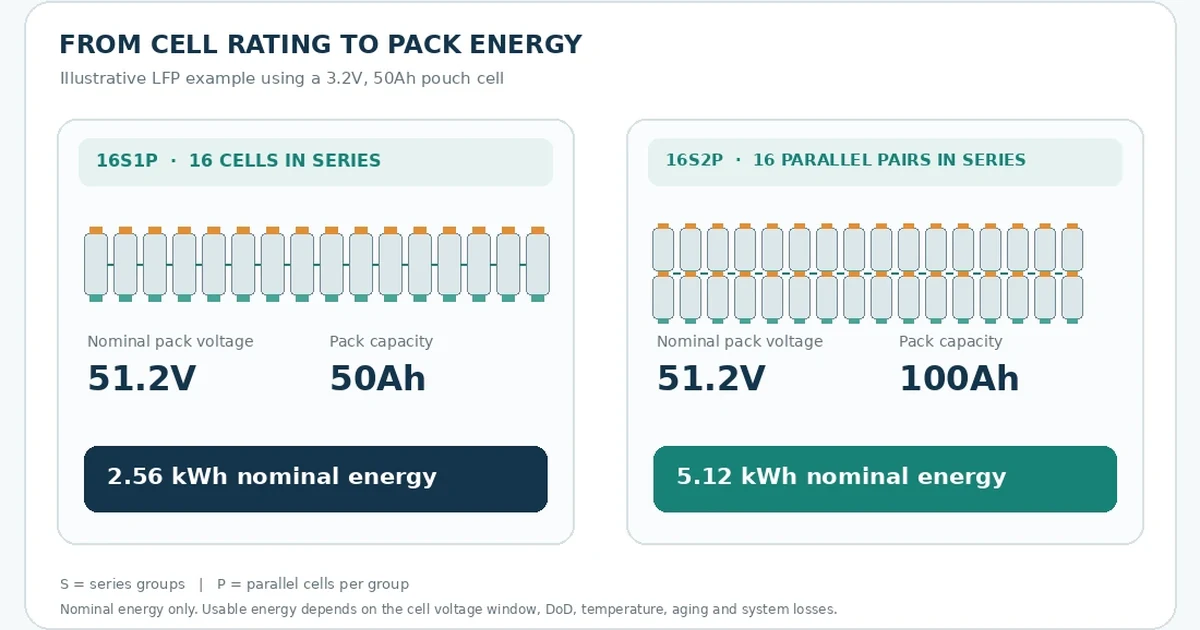
Nominal cell energy (Wh) = Nominal voltage (V) × Rated capacity (Ah) For example, a 3.2V 50Ah cell provides 160Wh of calculated nominal energy.
Series connections increase pack voltage. Parallel connections increase amp-hour capacity. Using a 3.2V 50Ah cell as a simple illustration:
| Configuration | Cell count | Nominal voltage | Capacity | Nominal energy |
| 16S1P | 16 | 51.2V | 50Ah | 2.56kWh |
| 16S2P | 32 | 51.2V | 100Ah | 5.12kWh |
| 16S3P | 48 | 51.2V | 150Ah | 7.68kWh |
A 16S LFP string has a nominal voltage of 51.2V. If—and only if—the selected cell specifies a 3.65V charge limit, the corresponding theoretical full-charge voltage is 58.4V (16 × 3.65V). Charger settings, BMS thresholds and the usable voltage window must follow the exact cell datasheet and system requirements.
Usable energy is lower than nominal energy in most real installations. Depth of discharge, inverter efficiency, temperature, cell aging, auxiliary loads and reserve settings all affect the energy available to the load. Do not publish a usable-kWh figure until these assumptions have been defined.
4. Compare Real LiFePO4 Pouch Cell Options
Misen Power lists several 3.2V LFP pouch-cell options that can be screened for ESS and custom battery-pack projects. The examples below show why capacity alone is not enough: dimensions, charging rate, discharge limits and the conditions behind reported performance all matter.
| Listed cell | Nominal rating | Dimensions | Published current information |
| Ganfeng 11165260 | 3.2V · 50Ah · approx. 160Wh | 10.5 × 165 × 260mm | 1C maximum continuous discharge (50A calculated); temperature/SOC derating applies. Standard charge is listed at 0.5C. |
| Ganfeng 53.5Ah | 3.2V · 53.5Ah · 171.2Wh | 11 × 120 × 350mm | 0.5C charge (26.75A) and 1C discharge (53.5A) based on the listed capacity. |
| Ganfeng LiEnergy 75Ah | 3.2V · 75Ah · 240Wh | 14.5 × 120 × 350mm | A 3C discharge condition is reported (225A by calculation); this does not establish a continuous-current rating. |
The 53.5Ah listing also gives a stated cell weight of 1.45kg and approximate internal resistance of 0.8mΩ. The 75Ah listing reports approximately 90% of nominal capacity at the stated 3C discharge condition and 80% capacity retention after 2,000 cycles; these figures should be treated as listing-reported information until the applicable original manufacturer test conditions are confirmed.
Important specification note: Product-page values are useful for preliminary screening, not a substitute for the latest original manufacturer datasheet. Confirm cell revision, grade, dimensional tolerances, test method, temperature/SOC current limits and cycle-life end-of-test criteria before design release.
Explore the complete LiFePO4 pouch cell range to compare additional capacities and formats.
5. Mechanical Support and Thermal Design
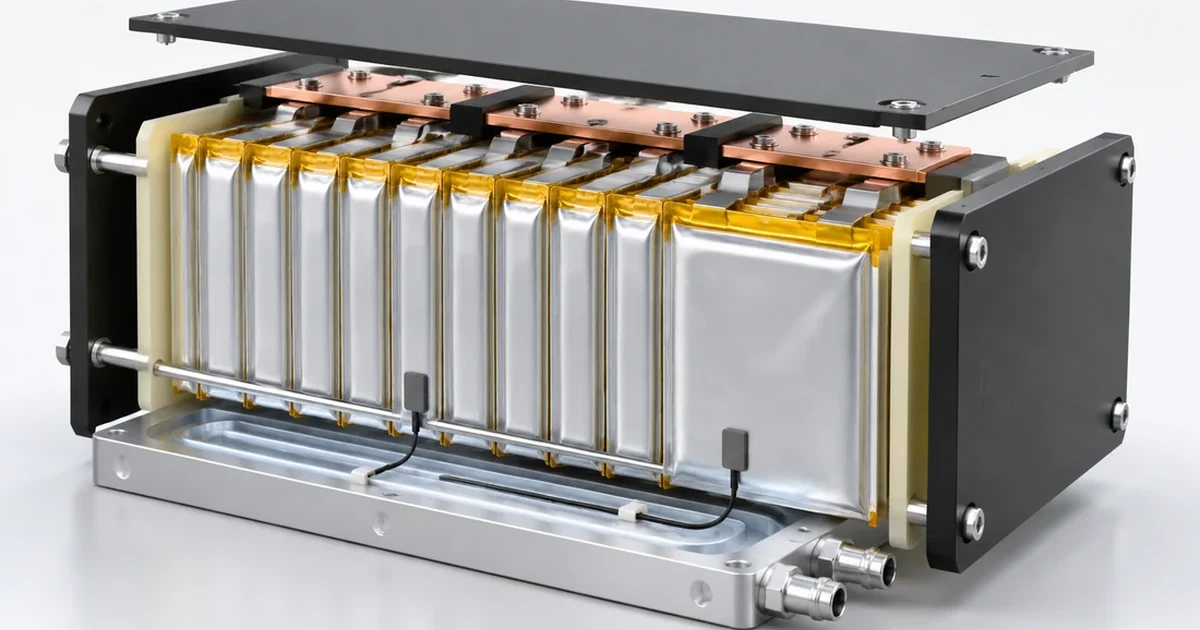
A pouch cell does not have the rigid metal can used by many cylindrical or prismatic cells. Its laminated enclosure needs suitable external support, controlled movement and protection for the tabs and edge seals. The module must also accommodate reversible thickness changes during operation and aging.
Before finalizing a module, review:
Compression: use the cell-specific preload range and support area; more pressure is not automatically better.
Expansion allowance: include dimensional tolerance and expected thickness change over the service life.
Tab and busbar layout: protect the seal area, maintain electrical clearance and avoid mechanical stress on the tabs.
Thermal path: define cooling plates or airflow, thermal interface materials and sensor positions.
Insulation and enclosure: prevent abrasion, conductive debris, moisture ingress and unintended contact.
For a deeper mechanical explanation, read Misen Power's guide to pouch cell compression in battery pack design.
6. BMS, Protection and ESS Integration
The BMS must be matched to the chemistry, series count, current profile and operating environment. For an LFP pouch-cell pack, the design review should cover individual cell-voltage monitoring, balancing, temperature sensing, overvoltage and undervoltage protection, overcurrent protection, short-circuit coordination and communication with the inverter or energy management system.
LFP's relatively flat discharge-voltage curve can make voltage-only state-of-charge estimation less informative across much of the operating range. The system may need current integration and periodic calibration in addition to voltage and temperature measurements. Sensor placement is also important: a temperature reading at one convenient point may not represent the hottest location in a large module.
Review the dedicated BMS Selection Guide for LiFePO4 Pouch Cell Systems when defining monitoring, balancing and protection requirements.
Cell chemistry does not make a battery system fireproof. The complete ESS still needs a project-specific safety strategy covering electrical isolation, fusing, contactors, enclosure design, fault detection, ventilation or venting, thermal event management and applicable installation codes.
7. What to Confirm Before Ordering Cells for an ESS Project
For a new ESS build, a supplier enquiry should include enough information to check both cell suitability and long-term sourcing. A practical request package includes:
Target nominal voltage, usable energy (kWh), continuous power and peak power.
Required charge/discharge profile, daily cycling, SOC window and operating temperatures.
Available cell envelope, module dimensions, tab orientation and connection method.
Original manufacturer datasheet, model/revision, cell grade and production-batch traceability.
Cycle-life test conditions: C-rate, DoD, temperature, compression fixture and end-of-life criterion.
Sample test plan for capacity, impedance, dimensions, charge/discharge behavior and module validation.
Do not mix cells with different capacities, models, ages or electrical characteristics in the same series string without a qualified engineering assessment. A nominally compatible voltage or similar external size does not prove that two cells are interchangeable.
For a step-by-step buyer checklist, see How to Choose Pouch Cells for Custom Battery Packs.
Frequently Asked Questions
Are LiFePO4 pouch cells suitable for ESS?
They can be suitable for residential, commercial and industrial storage when the cell's voltage, capacity, current limits, temperature range and mechanical requirements match the application. The finished module and ESS must be validated as a complete system.
How do I calculate the nominal energy of an LFP pouch cell?
Multiply nominal voltage by rated capacity. For example, a 3.2V 50Ah cell has 160Wh of calculated nominal energy. Usable energy depends on the permitted operating window and system losses.
What is the nominal voltage of a 16S LiFePO4 pack?
Using 3.2V nominal cells, a 16S string is 51.2V nominal. The maximum charging voltage must be calculated from the selected cell's specified charge limit, not assumed from the series count alone.
Do LiFePO4 pouch cells require compression?
Pouch cells need suitable external mechanical support and an expansion strategy. The preload force and assembly gap are cell-specific and should follow the manufacturer's mechanical guidance.
Can 50Ah, 53.5Ah and 75Ah pouch cells be mixed in one pack?
Do not treat them as interchangeable. Different capacities, dimensions, current limits and aging characteristics can create imbalance and uneven stress. Use a consistent qualified cell set unless a battery engineer has validated an alternative architecture.
Looking for LiFePO4 Pouch Cells for Your ESS Project?
Share your target voltage, usable energy, continuous and peak current, operating temperature, module dimensions and expected quantity. Misen Power can help review available LFP pouch cell options and discuss cell sourcing or customized battery-pack development.
Discuss Your ESS Project Technical note: Cell ratings and product examples in this article reflect information currently published on Misen Power product pages. Confirm the latest original manufacturer documentation and project-specific operating limits before procurement or system design.