Choosing between NMC, NCA and LFP is not a simple ranking exercise. These names describe cathode chemistry families, while a finished cell’s energy, power, lifetime and safety behavior also depend on its electrode design, materials, format and operating limits. For an OEM project, the useful question is which qualified cell can meet the pack’s energy, weight, space, temperature and duty-cycle requirements.
Quick answer
NMC and NCA are nickel-based layered-oxide chemistries often shortlisted when weight or package volume is constrained. LFP is a phosphate chemistry often shortlisted when thermal stability, cycle-life potential and long-term operating cost matter. These are family-level tendencies. Compare actual cell data under the same test conditions before choosing.
What do NMC, NCA and LFP mean?
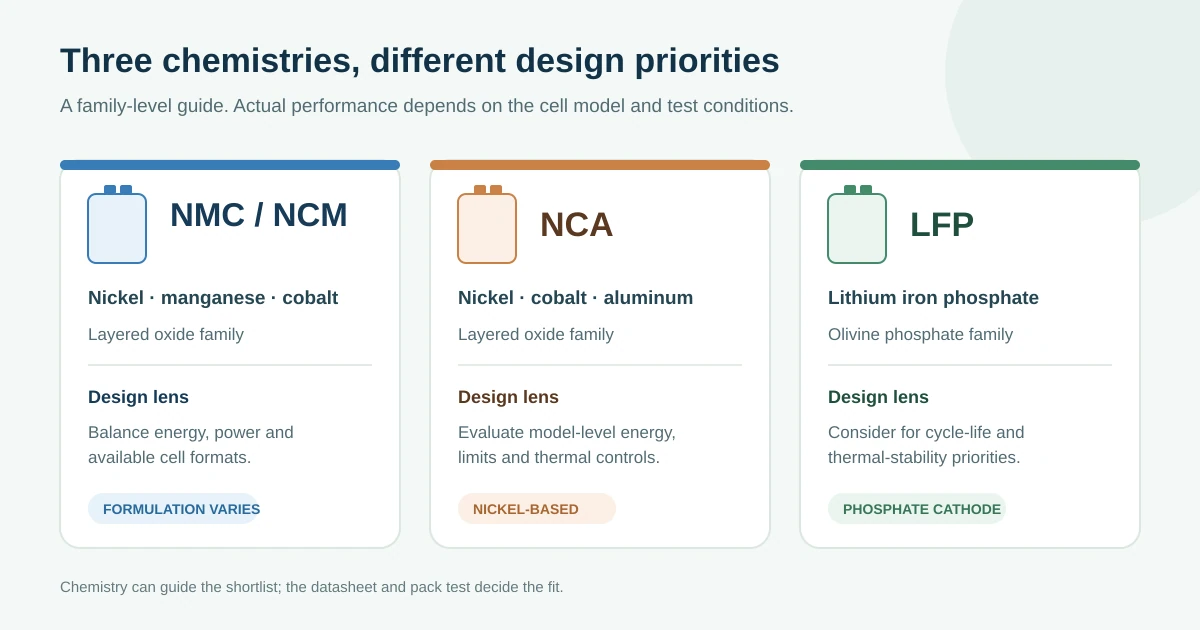
NMC (also written NCM) uses a layered cathode containing nickel, manganese and cobalt. Common composition labels include NMC 111, 622 and 811. The numbers describe relative metal proportions, and changing the nickel content changes the material trade-offs. “NMC” therefore covers a family of cells rather than one fixed performance profile.
NCA uses a nickel-cobalt-aluminum layered cathode. The main chemistry distinction from NMC is the use of aluminum instead of manganese in the cathode formulation. Both families can be engineered for high energy, and the chemistry label alone does not establish which finished cell will have higher usable energy, power capability or cycle life.
LFP (lithium iron phosphate, LiFePO₄) uses an olivine phosphate cathode. Its common nominal cell-voltage class is about 3.2 V, compared with roughly 3.6–3.7 V for many NMC and NCA cells. These are nominal values, not charge limits or a substitute for the cell maker’s voltage window. A Natural Resources Canada review groups NMC and NCA as nickel-based for a high-level comparison and cautions that performance varies with cathode composition, cell architecture and test conditions.
NMC vs NCA vs LFP: a practical comparison
Use this table to decide which chemistry families to investigate first. It summarizes broad tendencies, not guaranteed outcomes for every cell.
| Factor | NMC / NCM | NCA | LFP |
| Cathode family | Nickel-manganese-cobalt layered oxide; formulation varies. | Nickel-cobalt-aluminum layered oxide; formulation varies. | Lithium iron phosphate with an olivine structure. |
| Common nominal voltage class | About 3.6–3.7 V for many cells. | About 3.6–3.7 V for many cells. | About 3.2 V for many cells. |
| Energy and packaging | Can support high cell-level energy; compare the specific grade and format. | Often considered for high-energy designs; verify model-level Wh/kg and Wh/L. | Typically lower cell-level energy than nickel-rich designs; pack volume and mass may increase for the same target energy. |
| Thermal behavior and life | Depends strongly on formulation, operating window and cell design; requires qualified pack protection. | Assess the selected cell’s limits, lifetime data and thermal controls; do not infer them from the NCA label. | Phosphate cathodes are generally valued for structural and thermal stability and cycle-life potential. |
| First shortlist when | The project needs a balance of energy, power and available cell formats. | A specific qualified model may meet a demanding weight or volume target. | Long service, frequent cycling or thermal stability is a leading design priority. |
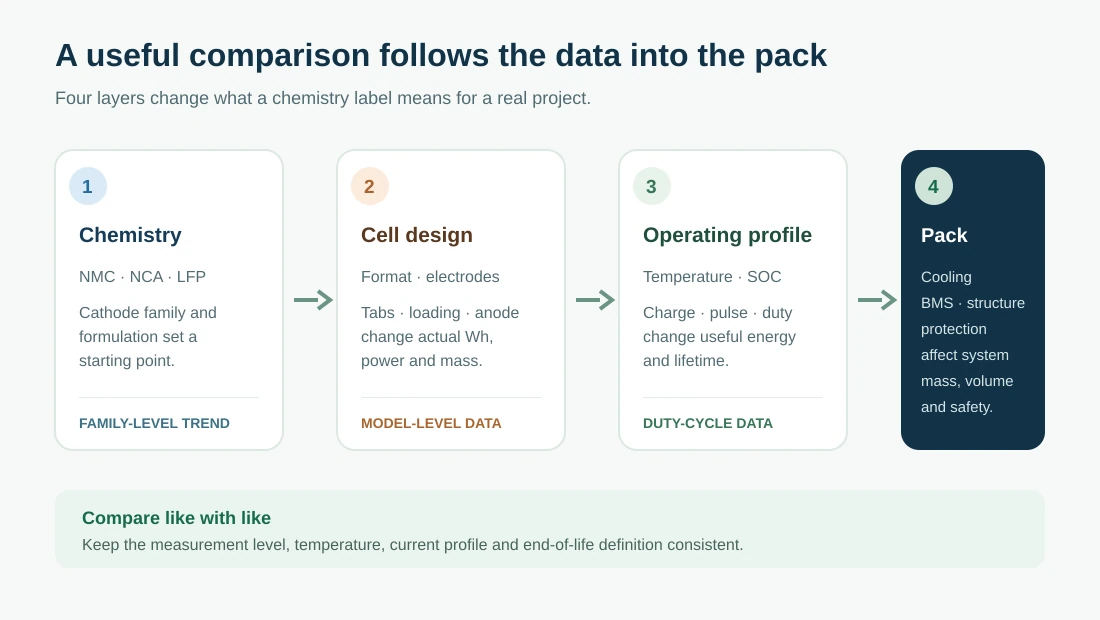
A chemistry comparison becomes misleading when it mixes cell-level and pack-level figures, or compares cycle counts measured at different temperatures, charge rates, depth of discharge and end-of-life thresholds. The Canadian report’s approximate comparison is useful for orientation, but it explicitly notes these limitations.
How are NMC and NCA different?
The practical difference is not simply “NCA has more energy” or “NMC lasts longer.” NMC’s nickel, manganese and cobalt ratio can be adjusted across multiple formulations. NCA also varies by supplier and cell design. The choice should be based on the candidate cell’s rated energy, current limits, voltage range, temperature limits and cycle-life test—not a single chemistry-wide ranking.
When comparing candidate NMC and NCA cells, ask for the same evidence from each supplier:
Rated and minimum energy under stated discharge conditions.
Gravimetric and volumetric energy at the cell level, with the cell format identified.
Continuous and pulse current limits across state of charge and temperature.
Cycle-life conditions, capacity-retention threshold and mechanical fixture requirements.
Cell revision, traceability, safety-test evidence and supply continuity.
A higher-energy cell can be useful when it reduces pack mass or volume enough to offset its thermal-management, protection and packaging requirements. Compare the finished pack, not only the cell chemistry.
Compare the pack, not just the cell
Cell-level Wh/kg and Wh/L are useful filters, but they do not equal pack-level energy density. A complete pack also includes interconnects, busbars, compression or support structures, cooling, sensors, BMS, fuses, contactors and an enclosure. Their mass and volume affect the system comparison.
Voltage also changes system architecture. A lower nominal cell voltage may require a different series count to reach the target pack voltage. The charger, BMS thresholds, inverter or motor controller, and available installation space must all match the chosen cell’s operating window.
For lifecycle cost, compare cost per usable energy delivered over the expected duty profile. Include cell price, pack hardware, expected energy window, thermal system, replacement assumptions, warranty terms and logistics. A low quote per amp-hour alone does not show which chemistry has the lower project cost.
Which chemistry should you shortlist?
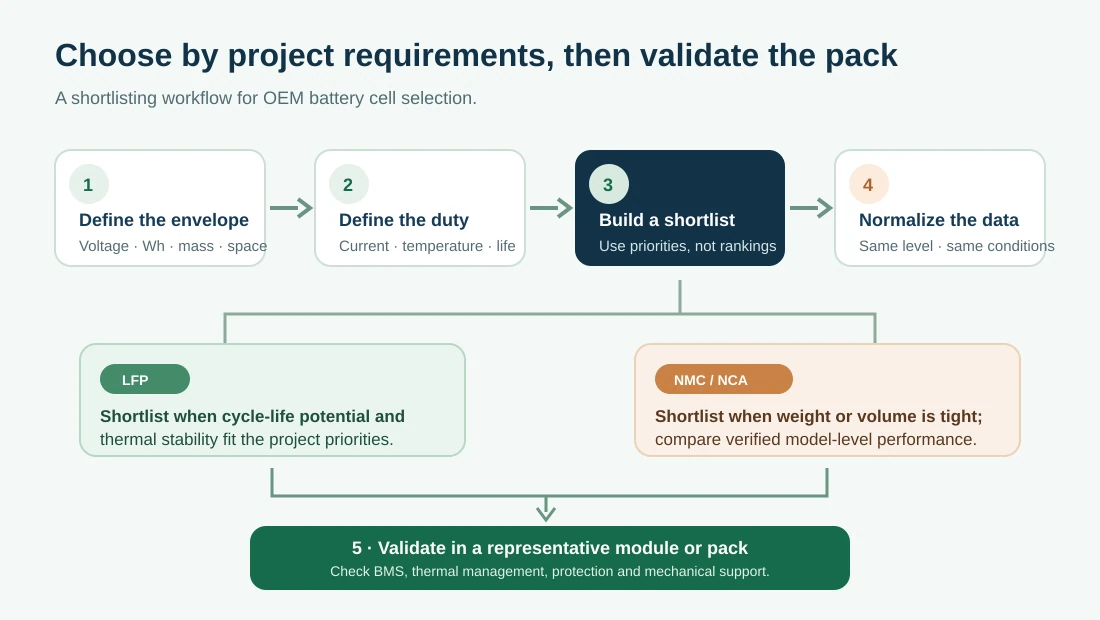
Start with the application’s limiting requirement. The following directions help build a shortlist; they do not replace model-level qualification.
Weight- or space-constrained mobility: compare qualified NMC and NCA candidates by actual cell energy, pack layout and thermal controls. Include LFP if the project can accept its potential mass or volume trade-off.
Stationary storage and frequent cycling: include LFP early when cycle-life potential, thermal characteristics and operating economics fit the duty profile. Compare NMC when footprint or specific power changes the business case.
High-power equipment: shortlist by the cell maker’s current-versus-time limits at the project’s temperature and state of charge. Chemistry names alone do not establish continuous or pulse capability.
Cost-sensitive projects: compare total pack cost and expected lifetime energy using the same load and service assumptions.
If your project is focused on pouch cells, see MisenPower’s LMFP, LFP and NMC pouch cell trade-offs for a related comparison. For current options, review NMC pouch cells and the LiFePO₄ cell range.
A procurement checklist for cell comparison
Define required pack voltage, usable energy, continuous power, peak power and allowable mass and dimensions.
Set the charge and discharge temperature range, state-of-charge window, duty cycle and service-life target.
Request current manufacturer datasheets, revision identifiers, test conditions, drawings and safety documentation.
Normalize candidate data at the same cell or pack level and under comparable operating conditions.
Validate the selected cell in a representative module or pack with the intended BMS, cooling and mechanical support.
Frequently asked questions
Is NCA always higher in energy density than NMC?
No. Some NCA cells are designed for high specific energy, but NMC covers a wide range of formulations and cell designs. Compare verified Wh/kg and Wh/L for the actual models using the same measurement basis.
Is LFP safer than NMC or NCA?
LFP’s phosphate cathode is generally valued for favorable thermal stability. Complete battery safety also depends on cell quality, operating limits, pack structure, electrical protection, thermal management and validation. No chemistry label is a substitute for system-level safety evidence.
Does LFP always have a longer cycle life?
LFP cells often have strong cycle-life potential, but the result depends on temperature, charge and discharge rates, depth of discharge, voltage window and the defined end-of-life threshold. Compare test conditions before using cycle counts in a project model.
Can I replace an NMC cell with LFP in an existing pack?
Usually not as a direct cell-for-cell substitution. Nominal voltage and operating windows differ, which can affect series count, charger settings, BMS limits, power electronics and pack dimensions. Recheck the complete electrical and mechanical design.
What information should I send for a battery cell recommendation?
Share the target voltage and usable energy, continuous and peak current with duration, cell or pack dimensions, mass limit, operating temperatures, duty cycle, expected service life and any required certifications. MisenPower can review the project requirements and discuss suitable available cell or pack options through its custom battery service.
Technical reference
Natural Resources Canada, Battery Technologies for Electric Long-Haul Trucks. The report provides an approximate NMC/NCA-to-LFP comparison and notes that cell chemistry, architecture and test conditions affect the results.
For a project-specific comparison, use the original cell manufacturer’s datasheet and verify the selected cell in the intended pack configuration.