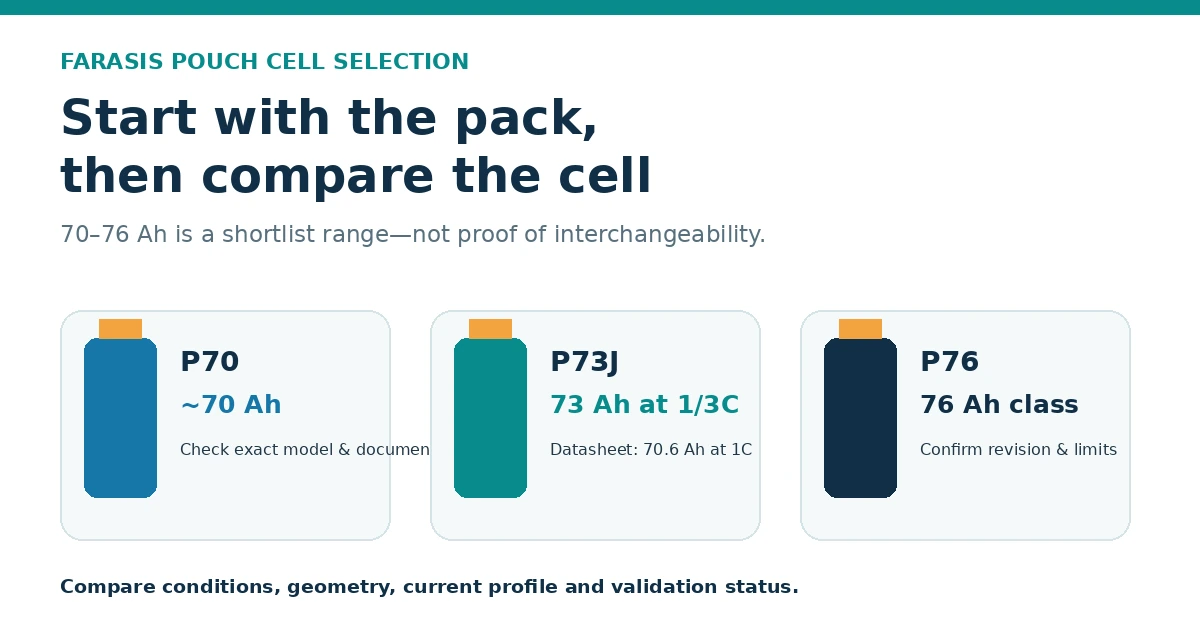
Choosing between the Farasis P73J, P70 and P76 is not a matter of selecting the largest amp-hour figure. A pouch cell must fit the pack envelope, voltage window, load profile, thermal limits and validation plan. The available P73J A1-2026 datasheet gives useful condition-specific data; P70 and P76 should be checked against their own exact manufacturer documents before any numerical comparison or substitution decision.
Quick answer: Start with the battery pack requirements, then verify the exact cell model and revision. For P73J, do not treat 73 Ah as a universal capacity value: the supplied datasheet lists 73 Ah at 1/3C and 70.6 Ah at 1C. Confirm comparable test conditions for P70 and P76 before ranking capacity, energy or performance.
First, confirm what each model name represents
The model name is an identifier, not a complete specification. Similar capacity labels do not establish the same electrode design, dimensions, voltage limits, current capability, cycle-life conditions or production revision. A cell with a different terminal layout or thickness may require a different module design even when its nominal capacity is close.
The MisenPower Farasis MP14104294P73J product page identifies the product associated with the selected P73J model. For engineering use, request and match the manufacturer datasheet revision, drawing, batch records and quotation details. A product page is a navigation aid; it is not a substitute for the controlled specification for the exact order.
Read the P73J figures with their test conditions
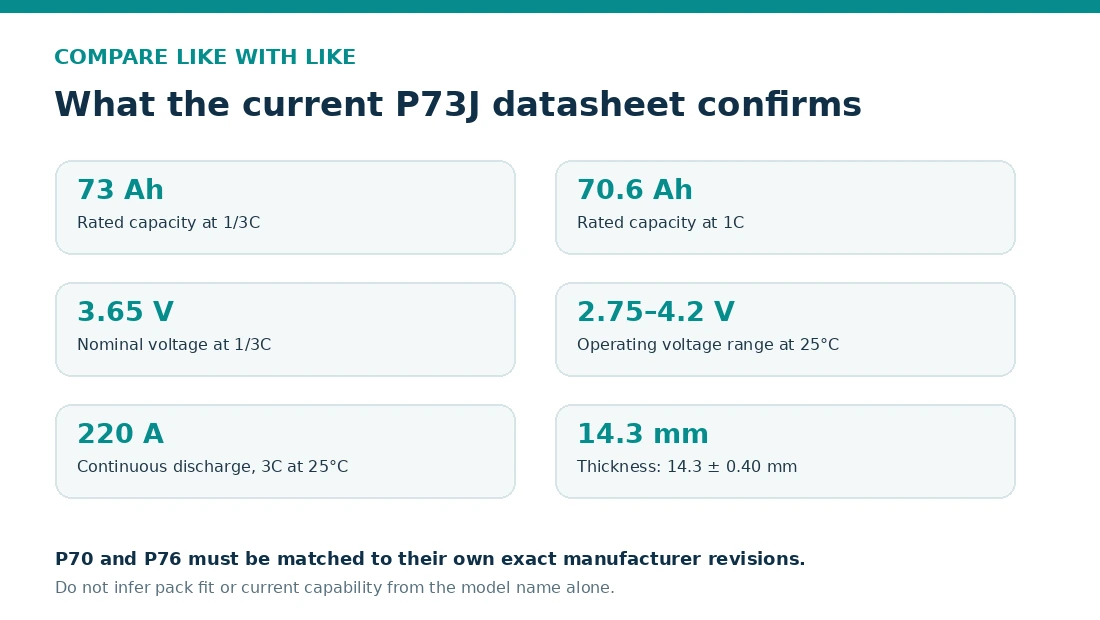
The supplied Farasis datasheet is for cell model MP14104294P73J, revision A1-2026. It reports the following values under the stated conditions:
| Item | P73J datasheet value | Condition / interpretation |
| Rated capacity | 73 Ah / 70.6 Ah | At 1/3C / 1C respectively; 4.25 V to 2.5 V at 25°C is stated on the sheet. |
| Rated energy | 267 Wh / 255 Wh | At 1/3C / 1C respectively. |
| Nominal voltage | 3.65 V / 3.6 V | At 1/3C / 1C respectively. |
| Operating voltage | 2.75–4.2 V | At 25°C, per the datasheet. |
| Continuous discharge | 220 A (3C) | At 25°C; cell-level figure, not a pack rating. |
| 10-second pulse | 175 A charge / 325 A discharge | At 25°C and 50% SOC, as specified. |
| Dimensions and mass | W 103.9 ± 1 mm; L1 294.4 ± 1 mm; L2 350.4 ± 3 mm; T 14.3 ± 0.40 mm; 934 ± 10 g | Check drawing, tabs and clearances in the actual pack design. |
| Cycle life | ≥1,500 cycles | 1C/1C, 25°C, to 80% SOH, per datasheet. |
These values should not be mixed across rows as though they were all measured at one rate. The datasheet's 1/3C and 1C capacity and energy values differ. Likewise, the 10-second pulse values are not continuous current ratings, and the continuous cell rating does not by itself establish what a completed pack can safely deliver.
How to compare P73J with P70 and P76
Use the same comparison template for all three candidates, but fill it only from documents tied to the exact model and revision being offered. For the P73J, the A1-2026 datasheet provides a defined set of values. For P70 and P76, verify the exact model code and current manufacturer datasheet before entering capacity, voltage, dimensions, current limits or cycle-life values. A nominal model label or an online listing should not be used to infer missing performance specifications.
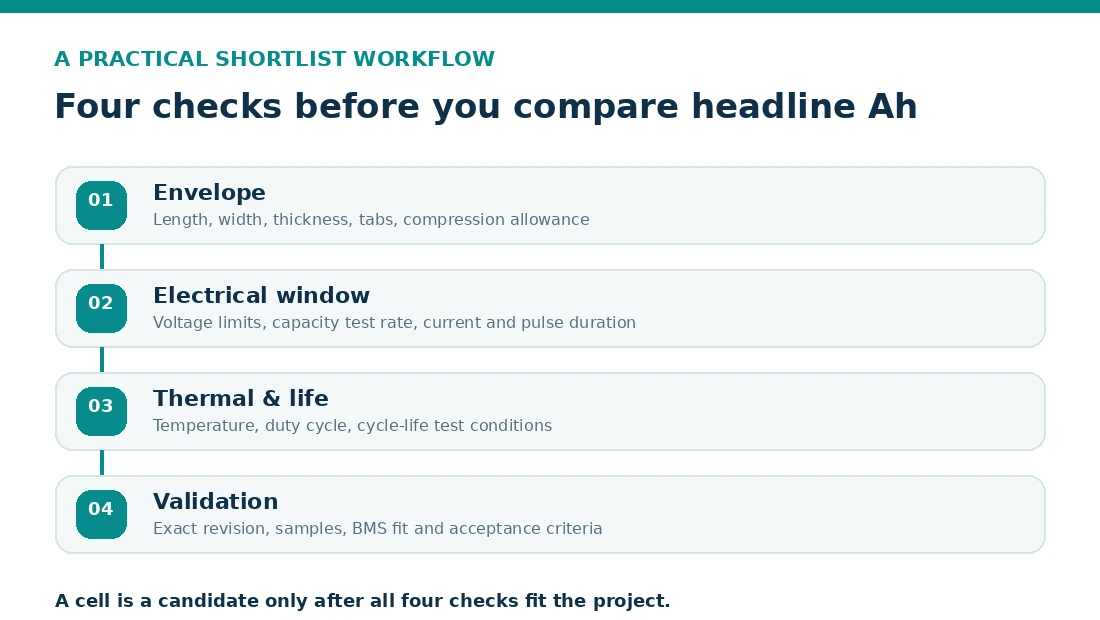
1. Check the physical envelope
Compare the complete cell outline, thickness range, L1/L2 references, tab position and polarity. Include insulation, busbar clearance, end plates, swelling allowance and the mechanical compression strategy. A few millimeters can change a module design; a similar Ah rating cannot make a cell a drop-in replacement.
2. Match capacity and energy test conditions
Record the discharge rate, temperature, upper and lower voltage cutoffs, rest periods and end-of-test criteria used for each capacity figure. Compare like with like. If one datasheet reports capacity at 1/3C and another at 1C, first align the test condition or treat the values as non-comparable. For preliminary energy sizing, use the manufacturer's stated Wh value under its stated condition; pack usable energy depends on the full operating window and system limits.
3. Separate continuous load from short peaks
Write down the continuous current, peak current, peak duration, frequency and SOC range expected in the vehicle. Check cell temperature and cooling conditions too. A brief pulse rating cannot be substituted for a continuous rating. Then review parallel count, interconnects, fusing, BMS limits and thermal paths at pack level.
4. Review cycle life and operating temperatures
Cycle-life numbers only make sense with charge/discharge rates, voltage limits, temperature, depth of discharge and end-of-life threshold. For P73J, the supplied datasheet states at least 1,500 cycles at 1C/1C and 25°C to 80% SOH. Compare the P70 and P76 figures only after confirming equivalent test criteria. Also check charging and discharging temperature windows against the actual vehicle duty cycle.
Build a project-specific shortlist
A practical shortlist should record the candidate model and revision, the source document date, dimensions, voltage window, capacity and test rate, continuous and pulse limits, temperature limits, cycle-life condition, sample availability and open questions. Mark every value as datasheet-confirmed, listing-stated or awaiting confirmation. That simple evidence label prevents preliminary supplier information from being mistaken for an approved design input.
Before choosing a sample, define what success means: mechanical fit, capacity test method, discharge profile, temperature rise, BMS compatibility and acceptance tolerances. If the cell is intended to replace an existing one, validate the module geometry and system controls—not just the cell outline.
Common selection mistakes
Choosing the highest Ah label before checking whether the cell fits the module.
Comparing capacity values measured at different C-rates, temperatures or cutoff voltages.
Treating pulse current as a continuous discharge rating.
Assuming that a later model revision is electrically and mechanically interchangeable without validation.
Using a cell-level specification as though it were a guaranteed battery-pack performance rating.
Frequently asked questions
Is the P73J a 73 Ah cell?
The supplied A1-2026 datasheet lists 73 Ah at 1/3C and 70.6 Ah at 1C. State the test rate when quoting the capacity.
Can P73J replace a P70 or P76 cell?
Not from the model names alone. Compare dimensions, tabs, voltage limits, current profile and thermal conditions, then validate the cell in the intended module and BMS configuration.
Is P73J's 220 A rating a battery-pack continuous current?
No. The datasheet lists 220 A (3C) as continuous discharge current at 25°C for the cell. Pack limits depend on cell arrangement, cooling, interconnects, BMS, fuses and operating conditions.
What should I request before ordering samples?
Request the exact model and revision, controlled datasheet, mechanical drawing, batch and test information, sample quantity and lead time. Agree a test plan and pass criteria that match the actual application.
Technical references
Farasis Energy, MP14104294P73J Performance Specifications, revision A1-2026, supplied for this article. All P73J numerical values above retain the datasheet conditions.
Farasis P70 and P76: confirm current manufacturer datasheets and drawings for the exact candidate revision before design use.
Select the cell around the complete pack requirement
P73J, P70 and P76 can be shortlisted within a similar capacity range, but the right choice depends on verified specifications and the design envelope. Start with fit and load profile, compare only equivalent test conditions, and validate the sample against the pack and BMS. Share your target voltage, dimensions, current profile, temperature range and project quantity to review suitable pouch cell options with MisenPower.