
Views: 0 Author: Site Editor Publish Time: 2026-10-26 Origin: Site


LMFP, LFP and NMC pouch cells all use a flexible laminated pouch enclosure, but their cathode chemistries lead to different voltage profiles, energy-density potential, thermal behavior and design trade-offs. For OEM engineers, LMFP is a promising higher-voltage phosphate option, LFP is a proven choice for stability and long-service-life applications, and NMC is often selected where mass and volume are critical. None is automatically best for every battery pack.
Quick answer
Start with the duty cycle, not a chemistry ranking. Compare manufacturer-qualified energy (Wh), voltage window, current versus temperature and state of charge (SOC), cycle-life test conditions, cell dimensions, and required pouch support. LMFP's manganese contribution can raise phosphate cathode voltage, but cell-level benefits depend on formulation and engineering.
All three are lithium-ion cathode families. LFP (lithium iron phosphate, LiFePO₄) uses an iron-phosphate olivine structure. LMFP (lithium manganese iron phosphate, LiMnₓFe₁₋ₓPO₄) replaces some iron with manganese, adding a higher-voltage redox contribution. NMC (lithium nickel manganese cobalt oxide, also called NCM) is a layered-oxide family whose properties vary considerably by nickel content and electrode formulation.
| Selection factor | LFP | LMFP | NMC / NCM |
|---|---|---|---|
| Cathode family | Iron phosphate | Manganese–iron phosphate | Nickel–manganese–cobalt layered oxide |
| Voltage behavior | Relatively flat discharge plateau; common cell nominal voltage ~3.2 V | Fe and Mn voltage contributions; nominal value is formulation-specific | Sloped voltage curve; common nominal values ~3.6–3.7 V |
| Main opportunity | Thermal stability, mature supply and cycle-life potential | Higher energy potential than comparable LFP formulations without nickel or cobalt in the cathode | High cell-level energy potential for weight- and space-sensitive designs |
| Important caveat | Lower nominal voltage; cold-temperature limits still apply | Rate performance, manganese dissolution and aging need careful validation | Greater attention to thermal propagation and voltage/SOC management |
This is a qualitative comparison of chemistry families, not a performance specification or an across-the-board ranking of finished cells. Cathode chemistry is only one part of cell construction: graphite or silicon-containing anodes, electrode loading, electrolyte, separator, tab geometry and manufacturing control also matter.
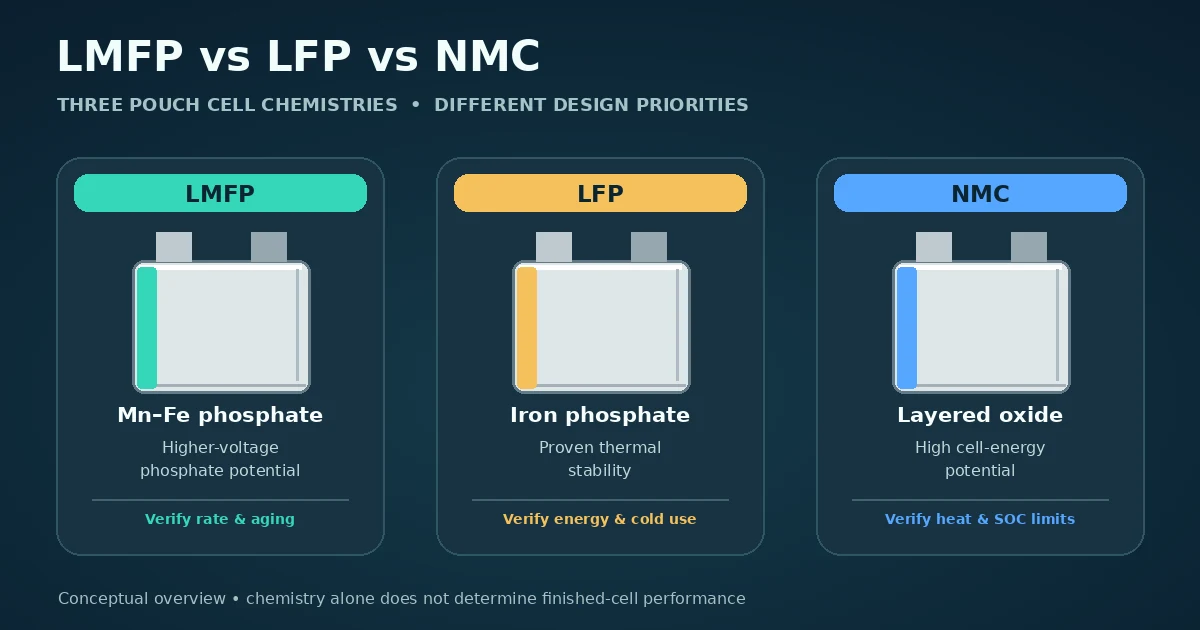
The iron-related electrochemical plateau in phosphate cathodes is around 3.4–3.5 V versus Li/Li⁺, whereas the manganese contribution is around 4.0–4.1 V versus Li/Li⁺. These are electrode potentials, not finished pouch-cell nominal voltages. LMFP composition, usable capacity on each plateau, anode chemistry and cut-off limits determine a particular cell's actual voltage and energy. This is why an LMFP label alone cannot establish its charge limit, nominal voltage or watt-hours.
For a first-pass calculation, nominal energy (Wh) ≈ specified nominal voltage (V) × capacity (Ah). For example, two hypothetical 45 Ah cells rated at 3.2 V and 3.7 V yield 144 Wh and 166.5 Wh respectively. The arithmetic demonstrates the role of voltage; it is not a measured LMFP-versus-LFP result or a promise of usable pack energy.
Battery engineers should compare delivered Wh across the intended SOC and temperature window, then include pack-level mass and volume: compression plates, interconnects, cooling, BMS, protective devices and enclosure. A higher-energy cell may not deliver the same advantage once system hardware and service-life constraints are included. NMC commonly offers high gravimetric energy potential; an optimized LMFP design aims to narrow the gap while retaining a phosphate-based cathode.
Do not infer discharge capability from chemistry alone. A power-optimized NMC pouch may outperform an energy-optimized NMC pouch; the same principle applies to LMFP and LFP. Electrode thickness, resistance, cooling and voltage sag often explain the practical difference between two candidate models.
Continuous discharge: ask for the current limit at the actual cell temperature, SOC and cooling conditions. A C-rate multiplied by Ah gives a nominal current, not a validated pack-level capability.
Pulse discharge: confirm pulse duration, initial SOC, rest interval, voltage limit and thermal recovery. Never present a 10-second pulse rating as continuous.
Charging: evaluate permitted current versus SOC and temperature, not only the fastest advertised C-rate. Cold charging can increase lithium-plating risk in graphite-anode cells.
Winter operation: compare capacity retention, DC resistance, allowable charge current and any preheating strategy at the project's minimum temperature.
LMFP offers an instructive example: adding manganese can increase average operating voltage, but high-manganese formulations can face slower reaction kinetics and interfacial degradation. Carbon coatings, particle engineering and electrolyte additives may mitigate these limitations; their effectiveness has to be shown for the specific production cell.
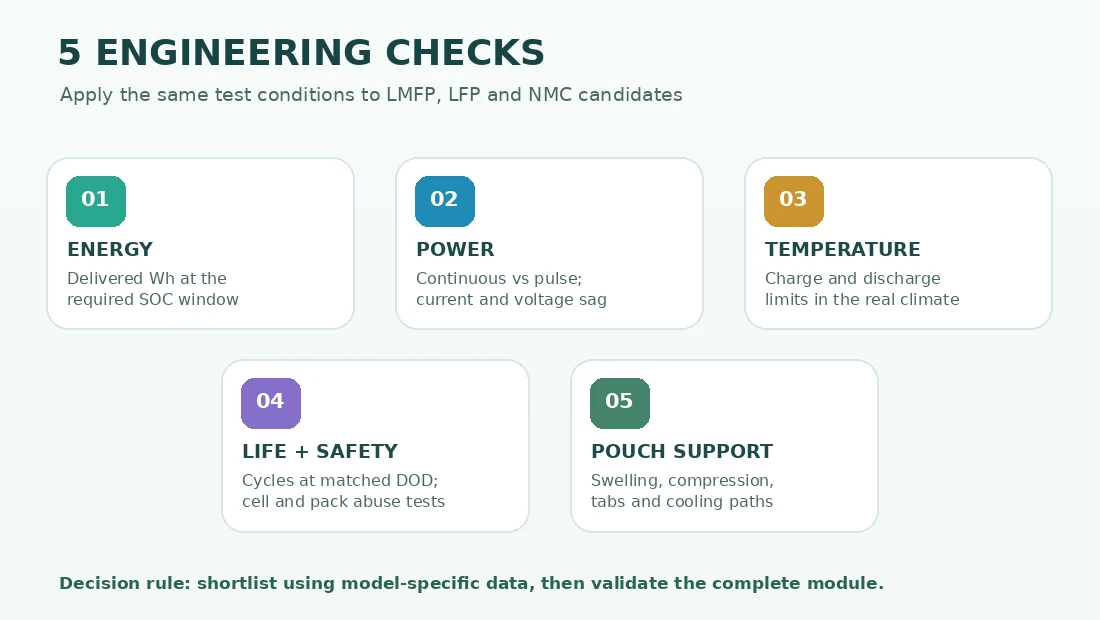
Phosphate cathodes are generally valued for their structural and thermal stability. LFP has an extensive commercial record, while LMFP seeks a voltage advantage within an olivine phosphate family. Many NMC formulations achieve higher energy but require careful assessment of heat release, propagation protection and high-SOC storage. No lithium-ion cell is fireproof or exempt from system-level protection. Abuse response must be verified using the actual cell and pack configuration.
Cycle life is especially easy to misinterpret. “3,000 cycles” means little without the depth of discharge, charge/discharge rate, temperature, compression or fixture condition, end-of-life capacity criterion and definition of one cycle. LMFP should not automatically inherit every LFP lifetime assumption: research identifies manganese dissolution and cathode/electrolyte interfaces as possible LMFP aging mechanisms. NMC lifetime, similarly, varies across grades and operating windows.
For purchasing, compare cost per delivered lifetime kWh, not just price per Ah. A useful evaluation combines qualified usable energy, expected cycles in the duty window, expected warranty failure rates, pack assembly and thermal hardware, safety validation and procurement availability. LFP often has a favorable materials cost structure; LMFP's economics depend on maturity and energy gained; NMC can justify cost where mass or packaging reduction has high system value.
An LFP, LMFP or NMC pouch cell does not have the rigid casing of a cylindrical or metal-can prismatic cell. Its laminated envelope requires suitable face support, tab and seal clearance, insulation, tolerance management, thermal paths and allowance for reversible and permanent thickness change. The correct fixture depends on the model—not just on the cathode family.
Fixed-gap plates and compliant compression systems behave differently as cells swell. Too little support can allow movement; excessive or uneven force can damage the cell or accelerate degradation. The assembly force, supported area, pressure distribution and end-of-life expansion should all be checked. For the full mechanical workflow, see MisenPower's guide to pouch cell compression and pack design.
Pack safety also involves voltage sensing, temperature monitoring, appropriate cell fusing, validated busbars and welded tabs, cooling, isolation, venting pathways and fault management. Selecting a thermally stable cathode does not remove these requirements.
For a practical starting point, MisenPower lists examples from all three families. These are different cell designs and capacities, so the figures below are orientation points, not a controlled head-to-head benchmark. Confirm original manufacturer documentation, revision, grade and availability before design release.
| Chemistry | Illustrative listing | What to verify |
|---|---|---|
| LMFP | EVE F16M, minimum 50.5 Ah | The listing gives 3C continuous at 25°C and 5C for 10 seconds above 50% SOC at 25°C. Obtain the OEM-rated nominal voltage and full current map. |
| LFP | Misen 98156271, 3.2 V / 45 Ah | Validate the duty-cycle current, mechanical tolerances, origin and test conditions for this listed LFP option. |
| NMC / NCM | LG E101, 3.7 V / 101 Ah | Confirm the applicable cell revision, actual energy, full electrical limits and life-test method. |
The F16M illustrates why details matter: MisenPower's technical section gives a minimum of 181.8 Wh under a 0.2C, 25 ±2°C, 2.5–4.2 V test window, and notes that source information did not establish a nominal-voltage value. Do not calculate energy from an assumed 3.7 V simply because that figure appears in a listing headline. Use the qualified energy and data-sheet conditions.
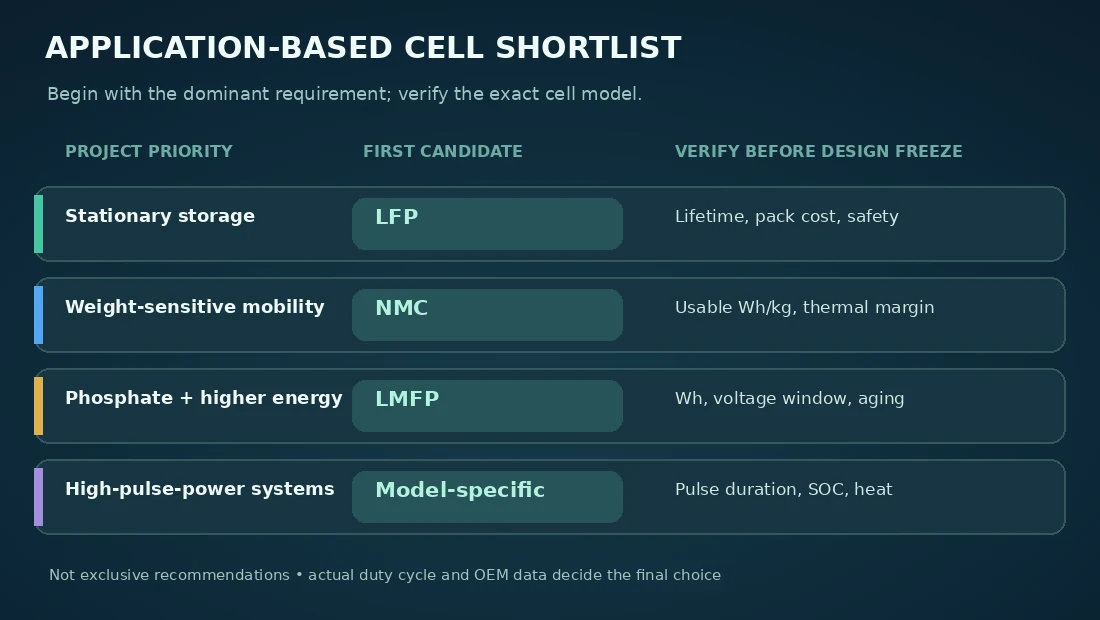
The following are shortlisting directions, not guaranteed chemistry winners. Real product selection should be supported by data-sheet screening and representative module testing.
Stationary storage and long-life industrial systems: shortlist LFP where thermal stability, mature production and operating cost are priorities; evaluate LMFP if higher energy per envelope creates useful value.
Weight-sensitive mobility or aerospace-adjacent equipment: NMC is often the first comparison because of energy-density potential, subject to required safety and environment qualifications.
Space-constrained mobility with a phosphate preference: evaluate LMFP against LFP using delivered Wh, required power, validated cycle life and pack hardware.
High-pulse-power machinery: shortlist by a manufacturer's current-versus-time-versus-temperature limits. Chemistry labels alone cannot predict output.
Define required pack Wh, peak and continuous power, allowable mass and module dimensions.
Specify charge/discharge temperatures, SOC window, cycle profile and calendar-life target.
Request original data sheets, electrical curves, current limits, safety-test evidence and mechanical drawings.
Compare delivered energy and heat generation under the same representative load profile.
Prototype the real support, cooling, interconnect, BMS and protection architecture.
Assess total pack cost, replacement interval, logistics and supply continuity.
LMFP partially substitutes manganese for iron in a phosphate cathode. It has a higher-voltage energy opportunity, but actual Wh/kg, rate capability and lifetime depend on the Mn/Fe ratio and the finished cell design. A universal percentage gain would be misleading.
Phosphate structures generally offer favorable cathode thermal stability, but full-cell and pack safety also depends on anode, electrolyte, SOC, manufacturing quality and protection design. Request comparable abuse-test evidence rather than treating chemistry as a safety certification.
Not as a drop-in substitution. Nominal and maximum voltage, charge profile, SOC estimation, cut-off thresholds, swelling, tab geometry and thermal behavior may differ. The BMS, charger, series count and mechanical assembly need requalification.
No universal model-to-model rule exists. LFP commonly offers strong cycle-life potential, but an NMC cell operated over a gentle SOC window can outperform a poorly matched or aggressively cycled alternative. Compare tests at equivalent conditions.
Usually the terms refer to the same nickel–manganese–cobalt oxide family; the letter order differs by convention. Exact composition such as NMC622 or NMC811 matters more than whether a product page says NMC or NCM.
LFP offers a proven phosphate baseline; LMFP extends the voltage opportunity; NMC remains an important high-energy option. The right answer is whichever qualified pouch cell meets the complete electrical, thermal, mechanical, lifetime and commercial specification with acceptable margin. Always validate representative cells in the intended module arrangement.
Need help shortlisting pouch cells?
Explore MisenPower's pouch cell solutions, then share your target voltage, Wh, current profile, dimensions, operating temperature and cycle-life requirements through our custom battery design service. We can help organize the technical comparison and documentation needed for an informed choice.
Technical references and scope
Advanced Propulsion Centre UK, L(M)FP Batteries for EV Adoption from a UK Perspective (2025), discussion of LMFP voltage, cost and thermal considerations.
RSC Sustainability, Ammonia-free synthesis of lithium manganese iron phosphate cathodes (2024), manganese redox and kinetic challenges.
EES Batteries, Interphase-driven failure pathways in LMFP/graphite pouch cells (2026), research on LMFP aging and electrolyte interaction.
Values described as typical or illustrative are not guaranteed specifications. Product listings are examples only; the model-specific OEM datasheet and qualification tests govern final battery design.


