
Views: 0 Author: Site Editor Publish Time: 2026-10-19 Origin: Site


Specifications, real-world pack design differences, and sourcing considerations for electric vehicle, industrial and energy storage battery projects.
The Farasis P75 74.9Ah NMC pouch cell and SK Innovation E777 77.7Ah NMC pouch cell are both long-format lithium-ion pouch cell options often considered when designing high-capacity battery modules. Their nominal capacities are close, yet electrical validation, thickness, tab design and documentation can be more important than the difference in ampere-hours.
This guide compares the public specifications, explains how to calculate nominal energy, identifies claims that need manufacturer confirmation, and shows how engineers and procurement teams can make an informed cell-selection decision.
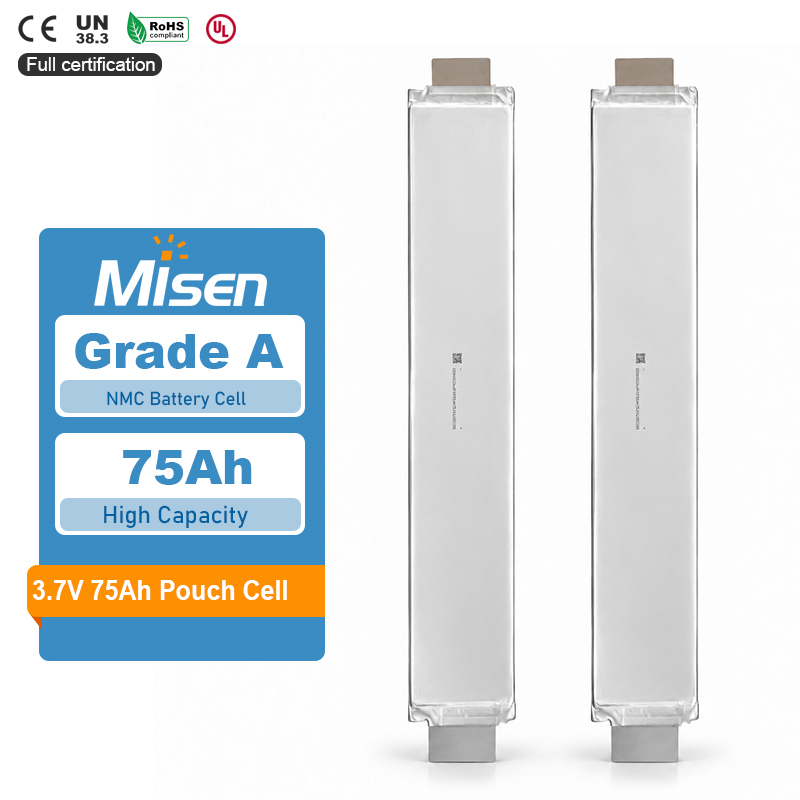 Farasis P75 · 74.9Ah |  SK E777 · 77.7Ah* |
Product images from Misenpower listings. *E777 is marketed as 77.7Ah in the title, while the same listing also contains 80Ah figures; confirm the exact variant before purchase.
| P75 OEM nominal capacity | P75 OEM specific energy | E777 product-title capacity |
|---|---|---|
| 74.9Ah | 267Wh/kg | 77.7Ah* |
P75 values refer to the 2026 Farasis cell catalogue at C/3 and 25°C. *E777 figure is from the Misenpower product title, not an independently verified OEM datasheet.
The Farasis P75 uses an NCM 8 cathode and graphite anode. In the Farasis Energy 2026 Cell Catalogue, its nominal voltage is 3.68V and its rated capacity is 74.9Ah, both specified at C/3 and 25°C. The same catalogue reports 267Wh/kg energy density, a 2.8–4.2V operating range and dimensions of 542 × 102 × 8.2mm.
Its published performance also includes an 18-minute charge from 10% to 80% SOC, an 8C discharge pulse for 10 seconds at 25°C and 50% SOC, and more than 5,000 standard cycles to 80% SOH at C/3 charge/discharge, 90% DOD and 25°C. These are specific test results, not universal guarantees for every battery pack or operating condition.
The SK E777 product listing is titled 3.7V 77.7Ah and identifies the cell as an NMC pouch format. The technical table on the same page, however, lists 80Ah / 296Wh, a 0.9kg weight and dimensions of 9 × 99 × 530mm. Public E777 supplier descriptions also vary in their weight and current-rating figures.
For preliminary layout screening, these figures help identify the approximate format, but the full SK part number, rated capacity, weight, charge/discharge curves, cycle test protocol and cell drawing should be verified from a matching OEM specification before final selection.
Important data-quality note: The two pages do not provide equally validated information. P75 figures below use the 2026 Farasis manufacturer catalogue where available. E777 figures are presented as Misenpower listing values only. Do not interpret an unverified E777 rating as directly comparable to an OEM-qualified P75 rating.
| Comparison item | Farasis P75 74.9Ah | SK E777 77.7Ah |
|---|---|---|
| Manufacturer / model | Farasis Energy P75 | SK Innovation / SK E777 (listed) |
| Cell technology | NCM 8 cathode / graphite anode; pouch | NMC lithium-ion pouch (listed) |
| Nominal capacity | 74.9Ah at C/3, 25°C | 77.7Ah in page title; 80Ah in table |
| Nominal voltage | 3.68V at C/3, 25°C | 3.7V in listing |
| Nominal energy | ≈275.6Wh (74.9Ah × 3.68V) | ≈287.5Wh using 77.7Ah × 3.7V; listing table states 296Wh at 80Ah |
| Cell dimensions | 542 × 102 × 8.2mm (L × W × thickness) | 530 × 99 × 9mm (listing values reordered) |
| Cell weight | 1,030 ± 15g (2026 OEM catalogue) | 0.9kg listed; exact variant must be checked |
| Gravimetric energy density | 267Wh/kg (OEM C/3, 25°C) | Not reliably established from matching OEM data |
| Voltage range | 2.8–4.2V (OEM) | Obtain the exact-model OEM datasheet |
| Discharge performance | 8C for 10s at 25°C, 50% SOC | 8C appears on product page without equivalent pulse/continuous conditions |
| Fast charge | 18 minutes (10–80% SOC) under manufacturer reference test | Charge-rate statements vary within listing; verify with OEM |
| Cycle life | >5,000 cycles to 80% SOH, C/3-C/3, 90% DOD, 25°C | 2,500+ cycles stated on page; test basis and other claims need reconciliation |
| Documentation basis | Farasis 2026 Cell Catalogue + Misen listing | Misen listing; model-specific OEM sheet requested |
Table basis: Farasis 2026 OEM catalogue, Misen P75 listing and Misen E777 listing. Values are preliminary screening data; dimensions and ratings must be confirmed against the purchased lot and exact OEM revision. P75 8C is a pulse value, not a continuous discharge rating.
The answer depends on which SK E777 capacity specification actually applies. Multiplying nominal voltage by capacity gives a useful nominal energy estimate, not measured usable energy:
| Calculation | Nominal cell energy | Basis |
|---|---|---|
| P75: 3.68V × 74.9Ah | 275.6Wh | Manufacturer-documented nominal figures |
| E777: 3.7V × 77.7Ah | 287.5Wh | Calculated from product-title capacity and listed voltage |
| E777: 3.7V × 80Ah | 296.0Wh | Calculated from the alternative 80Ah listing value |
On the 77.7Ah title-based assumption, E777 offers approximately 4.3% more nominal energy per cell than P75. If the 80Ah listing is the correct variant, the calculated difference would be about 7.4%. Neither result should be treated as a production-level comparison until the E777 capacity is reconciled with an exact OEM datasheet.
Figure 1. Nominal energy comparison based on the 77.7Ah E777 title figure
| Farasis P75 | 275.6Wh |
| SK E777* | 287.5Wh |
*E777 nominal-energy bar uses the 77.7Ah title figure; not an independent performance test. Bar lengths are illustrative; actual usable pack energy depends on voltage windows, SOC limits, temperature and design.
Energy per cell and energy density are different measures. Since E777 weight figures differ across public listings, it would be misleading to declare E777 either lighter or more energy-dense based on a single public weight value. For engineering decisions, request a verified measured mass and a capacity/energy test report for the exact batch.
Both cells belong to a long, narrow pouch format, but they are not automatically interchangeable. Using the two Misen product listings, P75 is approximately 12mm longer and 3mm wider, while E777 is listed about 0.8mm thicker than the P75 manufacturer specification. A few millimeters can matter when dozens of cells are stacked into a compressed battery module.
| Design check | Why it matters |
|---|---|
| Length, width and swelling allowance | Check the actual envelope, protective films and mechanical tolerances; nominal body dimensions alone are not enough. |
| Thickness under compression | Pouch thickness can vary with state of charge, age, compression force and test method. |
| Tab orientation and geometry | Tabs may use different metals, lengths, spacing and polarity arrangements, affecting welding and busbar design. |
| Cooling and cell support | Thermal contact area, cooling plate geometry and permitted compression must be checked separately. |
| BMS and voltage limits | Even a small nominal-voltage difference does not prove equal full-charge voltage, cutoff or protection thresholds. |

Pouch-cell terminal arrangement is a critical mechanical and electrical compatibility check. Product photo is illustrative; request the exact drawing for the quoted cell.
Replacement warning: Do not place P75 and E777 cells in the same series string, or replace one model with the other inside an existing module, merely because the nominal capacity is similar. Qualified pack engineers must validate voltage limits, resistance, state of health, dimensions, thermal characteristics and the BMS strategy.
For P75, Farasis specifically defines 8C for 10 seconds at 25°C and 50% SOC. At 74.9Ah, 8C corresponds to approximately 599A, but only within the published pulse-test conditions. It is not a 599A continuous-current rating. Continuous limits, pulse-rest intervals, allowed temperature rise and thermal-management requirements must be validated separately.
The E777 page also includes an 8C discharge figure but does not provide matching duration, temperature or SOC conditions in the same table. Therefore, the two 8C statements should not be treated as equivalent, and neither should be used to promise sustained pack output.
The P75 manufacturer catalogue gives 18 minutes from 10% to 80% SOC under its specified reference performance. Actual charging time depends on charger capability, pack-level cooling, temperature and the BMS. The E777 public page includes differing charge-rate descriptions; obtain the official charge-current and voltage profile before calculating a pack-level charging time.
Farasis reports more than 5,000 cycles to 80% SOH for P75 under C/3 charge/discharge, 90% DOD and 25°C. E777 cycle-life marketing figures do not establish a like-for-like result because the supporting test conditions, end-of-life definition and exact revision are not equivalently documented. Avoid ranking battery lifespan from headline cycle counts alone.
For a new design that prioritizes documented energy density, pulse performance, cycle testing and known voltage limits, P75 offers a strong starting point because a current manufacturer catalogue is available. E777 remains a candidate if its dimensions, price, sourcing conditions and confirmed OEM specifications are attractive for the intended duty cycle.
Compact industrial battery projects often combine short acceleration peaks, repeated charging and tight enclosure dimensions. In this category, compare the actual current profile and thermal load first. Ask for resistance-versus-SOC and temperature data, life testing at the intended duty, and mechanical constraints before picking a pouch cell.
For stationary energy storage systems, the best choice depends on usable energy, power-to-energy ratio, cycle profile, heat rejection, safety validation and delivered cost. Neither cell should be selected solely because it has a high Ah rating. Battery buffering, solar storage and backup applications require system-level BMS, fire safety and enclosure design in addition to the cell datasheet.
| Project priority | Suggested evaluation priority |
|---|---|
| OEM-documented pulse and cycle-test benchmarks | Start with Farasis P75 documentation, then validate against the actual duty. |
| Existing module designed around one exact cell | Prioritize an identical part number and revision; do not assume replacement interchangeability. |
| Potentially higher nominal Wh per cell | Screen E777 using verified 77.7Ah or 80Ah variant identification. |
| Minimal module thickness or footprint | Compare validated cell drawings, compression allowances and terminal geometry; neither is a guaranteed fit. |
| Bulk sourcing or repeat production | Require batch traceability, production date, grading method, sample test results and shipping documents. |
A purchase request is easier to qualify when the electrical and mechanical requirements are sent together. Before asking Misen Power for a quote, prepare the following information:
Exact cell identity: manufacturer, model code, suffix/revision, label and terminal photographs.
Quantity: prototype quantity, first production batch and forecast annual demand.
Pack architecture: series/parallel arrangement, operating voltage, energy target and available enclosure dimensions.
Power and charging: continuous/pulse current, pulse duration, charge current, temperature range and cooling approach.
Quality and traceability: new-cell grade, manufacturing date, lot number, inspection reports and matching technical drawings.
Logistics and documents: destination, packaging, UN38.3 test summary, SDS/MSDS and any application-specific compliance documents where required.
Misen Power offers sourcing information for Farasis P75 and SK E777. For alternative large-format cells, browse our NCM pouch cell category or send the battery pack specification for a technical review. Availability, lot identity, applicable certification and final specifications are confirmed at quotation stage.
P75 is a manufacturer-documented 74.9Ah, 3.68V NCM pouch cell. E777 is advertised on the linked product page as 77.7Ah, 3.7V, while its technical table shows 80Ah. Their nominal energy, cell geometry and supporting technical documentation differ; the exact E777 revision needs confirmation.
The Misenpower page uses 77.7Ah in the title and 80Ah in its parameter table. The correct rated and minimum capacities should be confirmed using the exact full model code, OEM datasheet and test results for the offered batch.
Using 77.7Ah and 3.7V from the E777 title/listing yields approximately 287.5Wh versus approximately 275.6Wh for P75: about 4.3% higher. However, this is a calculation from published figures, not a validated like-for-like discharge test.
No drop-in compatibility can be assumed. Check cell dimensions, tab geometry, voltage limits, DC resistance, compression, BMS calibration and the age of existing cells. Any replacement requires qualified engineering review.
The 2026 Farasis catalogue specifies 8C as a 10-second pulse at 25°C and 50% SOC, not a continuous discharge rating. Contact the manufacturer or supplier for the validated continuous-current limit.
The manufacturer catalogue reports more than 5,000 standard cycles to 80% SOH under C/3-C/3, 90% DOD and 25°C. Real-world life will differ with temperature, SOC range, charging speed, power demand and pack operation.
Neither cell is universally better. P75 is attractive when its published OEM benchmarks fit the project. E777 may suit other mechanical or sourcing requirements after its exact specifications are validated. Compare complete pack economics, thermal design and duty cycle.
Share the exact model or cell-label photo, required quantity, pack voltage/configuration, intended application, continuous and pulse current, delivery country, and required technical and transport documents.
Send Misen Power your required model, project quantity, application, target electrical performance and delivery destination. Our team can review cell sourcing options, available lot information and technical documents before you move to sample verification.
Contact Misen Power → | Explore More NCM Pouch Cells →
Farasis Energy Cell Catalogue 2026 (P75 technical specification) · Misenpower Farasis P75 product page · Misenpower SK E777 product page.
This article is a preliminary product comparison using the referenced public materials. It does not establish that the two cells are electrically or mechanically interchangeable. Test conditions, cell batch, exact model revision and OEM documentation take priority over marketing descriptions.


