
Views: 0 Author: Site Editor Publish Time: 2026-07-28 Origin: Site


Selecting the correct lithium-based chemistry dictates the operational lifespan, thermal safety, and overall footprint of an energy storage system. Engineers and procurement teams face a strict trade-off between maximizing cycle life and charge rates versus optimizing for energy density and upfront capital. This guide provides a direct, data-driven comparison between Lithium Titanate and Lithium Iron Phosphate chemistries. You will learn how to evaluate these technologies based on structural differences, performance metrics, and application-specific demands to support technical shortlisting.
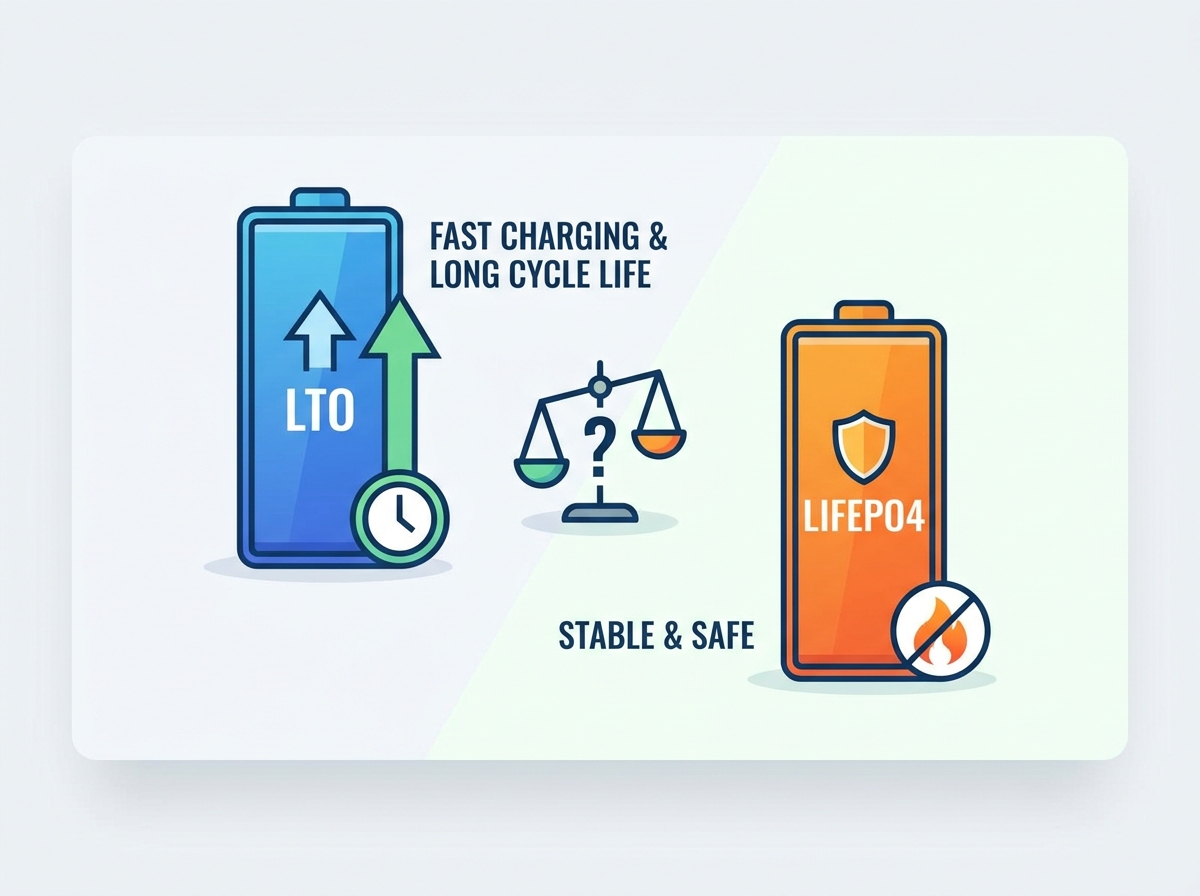
An LTO battery utilizes lithium titanate on the anode instead of graphite, resulting in exceptionally high cycle life (15,000–30,000 cycles) and rapid charge/discharge capabilities, but at the cost of lower energy density.
LiFePO4 batteries offer superior energy density and lower upfront costs, making them the standard for applications requiring sustained energy delivery within strict space and weight constraints.
LTO operates safely at extreme temperatures (down to -30°C) without lithium plating, whereas LiFePO4 requires thermal management for sub-zero charging.
An LTO battery modifies standard lithium-ion architecture by replacing the graphite anode with lithium titanate nanocrystals. This structural shift drastically increases the anode surface area. Graphite provides roughly 3 square meters per gram. Lithium titanate offers approximately 100 square meters per gram. This massive surface area enables rapid electron transfer. It allows the cell to absorb and deliver current at extreme rates without degrading the internal components. The lithium titanate anode also features a zero-strain property. It does not expand or contract during charge and discharge cycles. This physical stability prevents mechanical degradation over time, which is a primary failure mode in traditional lithium cells.
When you design systems around titanate chemistry, you leverage this structural stability to push massive currents. The nanocrystal structure facilitates rapid lithium-ion intercalation. This means the battery can charge in minutes rather than hours. Field engineers often deploy these cells in environments where downtime is unacceptable. The lack of carbon in the anode also prevents the formation of a restrictive Solid Electrolyte Interphase layer. This absence directly contributes to the massive cycle life and high-power capabilities of the cell.
Lithium Iron Phosphate cells utilize a standard carbon graphite anode paired with a lithium iron phosphate cathode. Strong covalent bonds exist between the iron, phosphorus, and oxygen atoms within the cathode. These bonds provide inherent thermal stability. They resist oxygen release under high heat. This makes the chemistry significantly safer than traditional Nickel Manganese Cobalt or Lithium Cobalt Oxide variants. LiFePO4 currently serves as the industry baseline for safe, bulk energy storage. It balances moderate energy density with reliable safety profiles.
The graphite anode in these cells functions similarly to standard lithium-ion batteries. Lithium ions intercalate into the graphite structure during charging. This process causes slight physical expansion and contraction. Over thousands of cycles, this mechanical stress slowly degrades the cell capacity. However, the iron phosphate cathode remains highly stable. This stability allows the battery to deliver consistent power over a long lifespan compared to older lead-acid technologies. You will find these cells in almost every modern solar storage array and recreational vehicle power system.
| Component / Property | Lithium Titanate | Lithium Iron Phosphate |
|---|---|---|
| Anode Material | Lithium Titanate Nanocrystals | Carbon Graphite |
| Cathode Material | Varies (often LMO or NMC) | Lithium Iron Phosphate |
| Anode Surface Area | ~100 m²/g | ~3 m²/g |
| Structural Strain | Zero-strain (no expansion) | Moderate expansion/contraction |
Energy density dictates how much capacity fits into a specific weight or volume. LiFePO4 holds a clear advantage here. It typically delivers a specific energy of 90 to 160 Wh/kg. This makes it ideal for space-constrained applications. When you build a power system for a marine vessel or a mobile clinic, every cubic inch matters. Iron phosphate cells allow you to pack sufficient kilowatt-hours into tight compartments without exceeding weight limits.
Conversely, lithium titanate chemistry prioritizes power over capacity. It typically yields 50 to 80 Wh/kg. You must allocate a larger physical footprint to achieve the same total energy capacity when using titanate cells. If you need 10kWh of storage, a titanate bank will be significantly larger and heavier than an iron phosphate equivalent. You must account for this during the structural design phase of your project. Reinforce battery racks and ensure adequate floor space before specifying titanate cells for bulk storage.
Specific power measures instantaneous current delivery. Specific energy measures total capacity. Titanate cells excel at high-current delivery. They often handle 10C continuous discharge and up to 30C peak rates. Their specific power ranges from 3,000 to 5,000 W/kg. This provides massive instantaneous surge output. If you operate heavy industrial winches or start massive diesel generators, titanate cells deliver the necessary amperage without voltage collapse.
LiFePO4 batteries typically support 1C continuous discharge. They peak around 2C to 3C. Their specific power sits between 1,400 and 2,400 W/kg. This makes them better suited for steady, long-duration discharge rather than rapid power dumps. If you try to pull 10C from a standard iron phosphate pack, the internal resistance will generate excessive heat. The Battery Management System will likely trigger an over-current shutdown. Always match your peak load requirements to the specific power capabilities of the chemistry.
| Performance Metric | Lithium Titanate | Lithium Iron Phosphate |
|---|---|---|
| Continuous Discharge | 10C | 1C |
| Peak Discharge (Surge) | Up to 30C | 2C - 3C |
| Specific Power | 3,000 - 5,000 W/kg | 1,400 - 2,400 W/kg |
| Fast Charge Capability | Full charge in 10-15 mins | Full charge in 1-2 hours |
Cycle life ratings typically assume an 80% Depth of Discharge. LiFePO4 batteries generally provide 3,000 to 6,000 cycles before reaching end-of-life capacity limits. For a solar array cycling once per day, this translates to roughly 10 to 15 years of reliable service. This longevity easily justifies the initial capital expenditure for most stationary storage projects. You install the bank, configure the charge controllers, and let it run with minimal maintenance.
Titanate cells far exceed this benchmark. They deliver 15,000 to 30,000 cycles or more. This longevity stems from the lack of Solid Electrolyte Interphase layer degradation. The zero-strain anode prevents the continuous breaking and reforming of this layer. Furthermore, titanate cells exhibit ultra-low self-discharge rates. They lose only 1% to 2% of their capacity per month. If you build a system that cycles multiple times per day, such as a grid frequency regulation plant, titanate is the only logical choice. It survives relentless cycling that would destroy iron phosphate cells within a few years.
Both chemistries maintain stability in high-heat environments. They perform reliably up to 55°C or 65°C. You can deploy either technology in desert climates provided you keep them out of direct sunlight. However, sub-zero performance reveals a stark contrast. Charging LiFePO4 below 0°C risks permanent lithium plating. The lithium ions fail to intercalate into the graphite anode. Instead, they build up as metallic lithium on the surface. This metallic buildup causes internal short circuits and permanently destroys the cell capacity.
Titanate chemistry eliminates this risk entirely. It safely charges and discharges at temperatures as low as -30°C. It suffers no significant capacity degradation or safety risks in freezing conditions. If you install remote telecom towers in northern Canada or Alaska, you cannot rely on iron phosphate without complex heating systems. Titanate cells allow you to build passive, unheated enclosures. They absorb solar charge even in the dead of winter without sustaining damage.
Nominal cell voltages differ significantly between the two technologies. LiFePO4 operates at a nominal 3.2V. Titanate cells operate at 2.3V or 2.4V. The full operating voltage window also varies. Titanate cells discharge down to 1.5V and charge up to 2.7V or 2.8V. Iron phosphate cells range from 2.5V minimum to 3.65V maximum. You must understand these ranges to design functional battery banks. You cannot simply swap one chemistry for another without redesigning the series and parallel connections.
This impacts system design directly. A 12V iron phosphate system requires four cells in series. A 12V titanate system requires five or six cells in series. For automotive integration, a six-cell titanate configuration aligns perfectly with high-output alternators. These alternators typically push 14.4V to 15.2V. This matches the titanate charge curve beautifully. You can connect a 6S titanate bank directly to a heavy-duty alternator without complex DC-to-DC chargers, provided your wiring handles the massive current draw.
Thermal runaway thresholds dictate catastrophic failure points. Both chemistries offer massive safety improvements over traditional lithium-ion cells. They resist thermal runaway under extreme stress. If a cell internalizes a short circuit, it will vent gas rather than erupting into flames. This inherent safety makes them suitable for indoor installations and mobile applications where human proximity is a factor.
However, titanate cells hold a slight edge in absolute safety. Their lower operating voltage and lack of a carbonaceous anode reduce combustible material within the cell casing. This makes them exceptionally stable under high heat or internal fault conditions. You can drive a nail through a titanate pouch cell, and it will barely register a temperature increase. Iron phosphate will get hot and vent smoke, though it rarely catches fire. For military or aerospace applications requiring absolute zero-fire risk, titanate is the superior choice.
Standardized testing, such as UL 1642 and UN 38.3, evaluates abuse tolerance. Both chemistries perform exceptionally well against mechanical penetration. They resist catching fire when punctured or crushed. They also handle overcharging and short-circuiting with minimal catastrophic risk. The testing protocols subject the cells to extreme vibration, altitude changes, and thermal shocks.
The structural integrity of the titanate anode provides superior resistance to mechanical shock and vibration over extended periods. The zero-strain nature means the internal layers do not micro-fracture under physical stress. If you mount batteries in heavy mining equipment or off-road vehicles, the constant pounding degrades standard graphite anodes. Titanate cells absorb this physical abuse while maintaining their electrical characteristics. They outlast the mechanical components of the vehicles they power.
Market maturity heavily influences initial procurement costs. LiFePO4 benefits from massive manufacturing scale. It is a highly commoditized product produced in massive gigafactories worldwide. This drives down the initial cost per kilowatt-hour. You can source high-quality iron phosphate cells for a fraction of the cost of specialized chemistries. This low CapEx makes it the default choice for residential solar, RV builds, and standard backup power systems.
Titanate technology remains a premium product. Higher raw material costs and lower production volumes keep initial capital expenditure higher. The manufacturing process requires precise control over the nanocrystal formation. You must weigh this higher initial investment against the operational demands of your specific project. If your application does not require extreme sub-zero charging or 30C discharge rates, spending the extra capital on titanate cells provides no tangible benefit. Allocate your budget efficiently based on actual engineering requirements.
Select titanate chemistry when power delivery and longevity outweigh space constraints. High-power applications require massive instantaneous current. Examples include heavy winch operations, high-end car audio systems, and hydraulic pump backups. Extreme climate deployments also demand this chemistry. Telecom towers in freezing environments rely on its sub-zero charging capability to maintain network uptime during winter storms.
High-frequency cycling applications benefit immensely from titanate cells. Automated guided vehicles in warehouse environments charge and discharge dozens of times per shift. Grid frequency regulation systems absorb and release massive amounts of power every few seconds to stabilize the local power grid. Titanate cells handle this relentless cycling without degrading. They eliminate the need for frequent battery replacement schedules, keeping critical infrastructure online continuously.
Choose iron phosphate when you need maximum capacity within a limited space. Marine vessels, recreational vehicles, and off-grid solar cabins require dense energy storage. You need to run air conditioners, refrigerators, and lighting for extended periods. Iron phosphate provides the deep capacity required for these sustained loads. It fits neatly into standard battery compartments and storage lockers.
Projects with strict upfront budget constraints should default to this chemistry. It excels in use cases with standard daily cycling. If your system charges during the day via solar panels and discharges at night, iron phosphate provides the most efficient balance of weight, capacity, and initial cost. It is the workhorse of the modern renewable energy industry. You will achieve excellent reliability without overspending on unnecessary high-power capabilities.
Using a standard lithium BMS on a titanate pack causes immediate problems. The voltage cutoffs will not match the cell architecture. A standard BMS expects a low voltage cutoff around 2.5V. A titanate cell operates down to 1.5V. The BMS will shut down the system prematurely, leaving massive amounts of energy trapped in the cells. This results in improper balancing and potential system failure.
You must specify a BMS explicitly programmed for the 1.5V to 2.8V cell range. Verify the firmware parameters before integration. Ensure the balancing current is sufficient to handle the large capacity of the cells. If you need assistance selecting the correct management hardware for your custom build, you can always contact us for engineering support. We help you match the exact BMS specifications to your chosen chemistry.
Vehicle configurations often suffer from voltage sag. Insufficient alternator output will fail to fully charge titanate packs. Standard vehicle regulators may not match the required charge curve. If you connect a 5S titanate pack to a standard 14.4V alternator, you will overcharge the cells. If you connect a 6S pack to a weak 13.8V alternator, you will never reach full capacity.
Use custom external voltage regulators to dial in the exact charge voltage required by your specific series configuration. Alternatively, install dedicated DC-to-DC chargers. Calibrate these devices for the specific chemistry curve. This ensures the battery bank receives a clean, regulated charge profile regardless of engine RPM or accessory load on the vehicle.
Engineers frequently underestimate the physical footprint of a titanate battery bank. The lower energy density demands more physical volume. You cannot simply drop a 100Ah titanate bank into the exact same space previously occupied by a 100Ah lead-acid or iron phosphate battery. The dimensions will be significantly larger.
Conduct a strict volumetric analysis during the early design phase. Measure the available installation space accurately. Account for cable routing, BMS mounting, and terminal clearance. If the space proves insufficient, you must pivot to iron phosphate and adjust your cycle life expectations accordingly. Do not force cells into tight enclosures where they cannot be properly secured or serviced.
Neither chemistry is objectively superior. The right choice depends entirely on your application's demand for power versus energy. Take the following steps to finalize your system design:
Calculate your peak instantaneous current requirements to determine if you need high specific power.
Measure your physical installation space to establish strict volumetric limits for the battery bank.
Assess the lowest expected operating temperature to decide if sub-zero charging capabilities are mandatory.
Define your daily cycle frequency to evaluate necessary operational longevity.
Verify that your selected Battery Management System matches the exact voltage parameters of your chosen chemistry.
A: Yes, but it requires careful configuration. A six-cell titanate pack aligns well with standard 12V automotive alternators. However, you must ensure your alternator output matches the charge acceptance rate and use a compatible BMS to prevent overcharging.
A: LiFePO4 offers a better balance of energy density and lower upfront manufacturing costs. It fits easily into standard consumer applications like solar storage and RVs, whereas titanate is reserved for specialized high-power or extreme-temperature industrial uses.
A: Generally, no. Its low internal resistance generates very little heat even during rapid charge and discharge cycles. However, extreme continuous C-rates in enclosed spaces may still require basic thermal management.
A: No, charging LiFePO4 below 0°C causes lithium plating, which permanently damages the cell. You must use internal heating pads or ambient climate control to warm the cells before initiating a charge cycle.
A: You must select a BMS programmed for the specific chemistry's voltage range. LiFePO4 requires cutoffs around 2.5V and 3.65V. Titanate requires cutoffs around 1.5V and 2.8V. Never mix BMS hardware between different chemistries.
A: Both are exceptionally safe and resist thermal runaway. LiFePO4 is the standard for residential solar due to its cost and capacity. Titanate is slightly safer due to its lower voltage and zero-strain anode, but its size makes it impractical for most homes.


