
Views: 0 Author: Site Editor Publish Time: 2026-07-31 Origin: Site


Standard lithium-ion batteries often come with optimistic lifespan projections that fail to materialize in the field. Lithium Titanate Oxide (LTO) chemistry fundamentally alters the mechanical realities of battery degradation. This technology offers lifespans that frequently outlast the equipment they power. Engineers, system integrators, and off-grid designers face a persistent challenge: standard battery chemistries fail prematurely in high-cycle, rapid-charge, or extreme-temperature environments. This leads to unacceptable replacement schedules and system downtime.
Evaluating an LTO battery requires moving beyond surface-level cycle ratings. We must break down the verified cycle life, calendar life, and degradation mechanics to determine if the upfront investment makes sense for your specific application. You need to understand exactly how these cells behave under heavy industrial abuse, sub-zero freezing conditions, and continuous rapid cycling.
Unmatched Cycle Life: LTO batteries reliably deliver between 10,000 and 30,000+ full Depth of Discharge (DoD) cycles before reaching 80% state of health (SoH).
Extended Calendar Life: Due to the absence of traditional Solid Electrolyte Interphase (SEI) layer degradation, LTO cells have a functional calendar life exceeding 20 to 25 years.
Extreme Condition Tolerance: LTO maintains its lifespan even under heavy abuse, including sub-zero temperatures (-30°C to -40°C) and ultra-fast charging (high C-rates) that would instantly destroy standard lithium chemistries.
The Primary Trade-off: The exceptional longevity of LTO comes at the cost of lower energy density (heavier/bulkier cells) and a significantly higher initial capital expenditure compared to LiFePO4 (LFP).
To trust the 30,000-cycle claims, you must understand the underlying chemistry that prevents premature failure. The fundamental structure of LTO cells dictates their durability. We see many battery technologies claim long lives, but they rely on gentle laboratory conditions. LTO achieves its lifespan through physical and chemical stability at the molecular level.
The lithium titanate nanocrystals in the anode experience near-zero volume expansion during charging and discharging. Measurements show this expansion is approximately 0.2%. This structural stability prevents the mechanical fatigue that destroys other batteries. When lithium ions enter and exit the spinel structure of the lithium titanate, the lattice remains rigid.
Contrast this with graphite anodes in standard lithium-ion batteries. Graphite expands and contracts by up to 10% with every cycle. This continuous physical movement causes mechanical stress, micro-cracking, and structural pulverization over time. The graphite literally grinds itself into dust after a few thousand cycles. LTO avoids this physical breakdown entirely, maintaining its structural integrity even after tens of thousands of rapid charge and discharge events.
Lithium ions intercalate into the lithium titanate spinel structure.
The crystal lattice accommodates the ions without shifting its physical dimensions.
Mechanical stress on the anode material remains negligible.
Micro-cracking and subsequent capacity loss are prevented.
LTO operates at a higher voltage potential than graphite. Specifically, it operates above the reduction potential of most organic electrolytes. This prevents the continuous formation and thickening of the Solid Electrolyte Interphase (SEI) layer. In standard lithium batteries, the SEI layer forms on the first charge and then continuously thickens over the battery's life, consuming active lithium and increasing internal resistance.
This chemical stability prevents the gradual increase in internal resistance and capacity fade that typically kills standard lithium batteries. The lack of SEI buildup ensures consistent power delivery over decades. You do not see the slow, creeping sluggishness in an LTO pack that you observe in aging NMC or LFP packs. The internal resistance remains flat for the vast majority of its operational life.
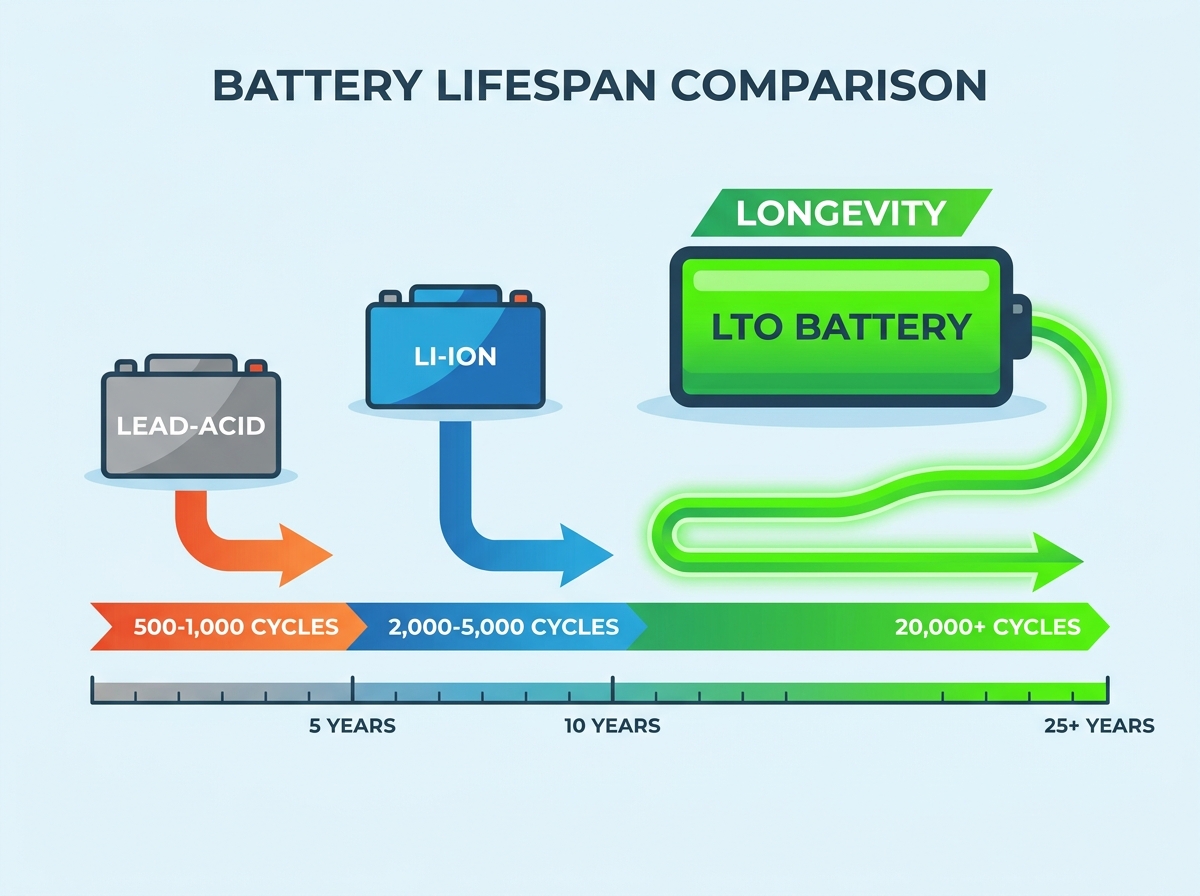
Separating active use metrics from chronological aging establishes accurate success criteria for energy storage systems. You must evaluate both how many times you can cycle the battery and how many years it will sit on a shelf or in a rack before degrading naturally.
Baseline cycle ratings range from 10,000 cycles under heavy industrial abuse to 30,000+ cycles in standard operating conditions. Tier-1 manufacturer laboratory benchmarks prove up to 25,000 continuous charge/discharge cycles before capacity compromise. We regularly see LTO packs in automated guided vehicles (AGVs) surpass 15,000 cycles with minimal capacity loss.
Translating cycles into years based on daily usage reveals massive longevity. At one full cycle per day, 10,000 cycles equate to over 27 years of continuous use. Reaching 25,000 cycles extends potential use beyond 70 years. In grid-frequency regulation applications where a battery might cycle five times a day, an LTO pack will still last 15 to 20 years. Standard lithium chemistries would burn out in two to three years under the same load.
Calendar life measures degradation over time regardless of active cycle use. Evidence supports a 20 to 25+ year calendar life for LTO cells. This means even if you only cycle the battery once a month, the internal chemistry will remain stable for over two decades.
Low internal resistance over time keeps the battery viable for decades. This remains true even in standby or float-charge applications where the battery is rarely cycled fully. Telecom backup sites and emergency power systems benefit greatly from this. You can install an LTO pack and reasonably expect it to outlast the building's primary electrical switchgear.
Benchmarking LTO against alternative energy storage solutions contextualizes its longevity and operational advantages. We must look at the hard data comparing LTO to LFP, NMC, and traditional lead-acid systems.
LTO delivers 10,000 to 30,000 cycles, while LFP typically manages 3,000 to 6,000 cycles. LTO features a linear, slow degradation curve. You can predict exactly what capacity you will have in ten years based on your cycle count.
LFP batteries eventually experience an internal resistance spike and sudden capacity drop. They hit a "knee" in their degradation curve where performance falls off a cliff. LTO avoids this cliff-edge failure mode, providing predictable performance right up to the end of its life.
LTO vastly outperforms NMC, which generally offers 500 to 2,000 cycles. Safety, chemistry, and thermal stability differences heavily impact physical operational lifespan. NMC is designed for energy density, packing as much power into a small space as possible, but it sacrifices longevity to achieve this.
NMC chemistries are prone to thermal runaway and rapid degradation under stress. If you overcharge or puncture an NMC cell, it catches fire. LTO remains stable and safe even when punctured, crushed, or severely overcharged. This physical robustness translates directly into a longer practical lifespan in harsh industrial environments.
Contrast LTO's deep discharge capabilities with lead-acid's severe sulfation and rapid degradation when discharged below 50% DoD. LTO provides 10,000 to 30,000 cycles compared to lead-acid's 300 to 500 cycles. Lead-acid requires constant maintenance and careful voltage management to prevent premature death.
In automotive and starter environments, LTO shows superior ability to withstand alternator charging profiles and high engine bay heat. Lead-acid batteries fail quickly under these conditions, often requiring replacement every three to four years. An LTO starter battery will likely outlast the vehicle itself.
| Chemistry | Cycle Life (100% DoD) | Calendar Life | Degradation Curve | Thermal Runaway Risk |
|---|---|---|---|---|
| LTO | 10,000 - 30,000+ | 20 - 25+ Years | Linear, Slow | None |
| LiFePO4 (LFP) | 3,000 - 6,000 | 10 - 15 Years | Gradual, then sudden drop | Very Low |
| NMC/NCA | 500 - 2,000 | 5 - 10 Years | Moderate to fast fade | High |
| Lead-Acid | 300 - 500 | 3 - 5 Years | Rapid if deeply discharged | None (Off-gassing risk) |
Identifying environmental and operational factors that impact theoretical lifespan ensures realistic deployment planning. Laboratory numbers mean nothing if the battery fails in the field due to environmental stress.
LTO operates without lithium plating in sub-zero climates down to -30°C or -40°C. Lithium plating is a primary cause of short-circuits and death for LFP and NMC batteries in the cold. When you charge a standard lithium battery below freezing, the lithium ions cannot intercalate into the anode fast enough. They pile up on the surface as metallic lithium, permanently reducing capacity and creating dangerous dendrites.
High-temperature stability up to 55°C is another major advantage. The impact on degradation is significantly lower compared to standard lithium chemistries. Heat accelerates the chemical reactions that degrade batteries. LTO's inherent chemical stability resists this heat-induced aging, making it ideal for desert deployments or hot engine bays.
LTO handles rapid charge and discharge rates up to 10C or higher. High C-rates do not cause local thermal hotspots or structural anode damage. You can charge an LTO pack from zero to full in six minutes if you have a powerful enough charger.
Other chemistries degrade rapidly under high C-rates. Pushing 5C into an LFP pack will cause massive heat generation and rapid capacity fade. LTO absorbs massive currents safely and efficiently due to its high surface area nanocrystal structure.
Determine the maximum continuous discharge current required by your load.
Verify the charge acceptance rate of the LTO cells (often 5C to 10C).
Size the busbars and cabling to handle the extreme current potential without melting.
Implement thermal monitoring, even though LTO runs cooler than other chemistries.
Discharging LTO to 0V does not instantly destroy the cell. Unlike other lithium chemistries, LTO can often recover from extreme over-discharge without catastrophic failure. If a parasitic draw drains an NMC battery to zero volts, the copper current collectors dissolve, ruining the cell. LTO does not suffer from this specific failure mode.
Defining the optimal voltage operating window maximizes the 30,000-cycle potential. Staying within recommended limits ensures maximum longevity. Typically, operating between 1.8V and 2.5V per cell yields the best balance of capacity and lifespan.
Identify where the lifespan of LTO justifies the weight trade-offs. You do not put LTO in a smartphone. You put it in applications where failure is not an option and replacement is difficult.
Applications requiring multiple rapid, high-power charge and discharge cycles per day benefit immensely. LTO handles constant cycling without rapid wear. Grid operators use LTO to smooth out power fluctuations from wind and solar farms, injecting and absorbing massive amounts of power in seconds.
Remote, unmanned installations where battery replacement logistics are prohibitively expensive require extreme reliability. LTO survives where temperatures fluctuate wildly. A telecom tower in northern Canada or a solar array in the Sahara desert are perfect environments for LTO.
Automated guided vehicles (AGVs) requiring 24/7 uptime rely on rapid opportunistic charging. Ten-minute top-ups do not degrade the LTO battery pack. The AGV docks, blasts a high-C charge into the battery, and returns to work immediately.
Replacing standard lead-acid car batteries with a lightweight, practically everlasting starter battery is highly effective. LTO delivers immense cold-cranking amps (CCA) and survives harsh engine bay environments. Car audio enthusiasts also use LTO banks to stabilize voltage during massive bass hits.
Audit your system's daily cycle requirements to determine if extreme longevity is necessary. Calculate the physical space available, as LTO will require more volume than LFP or NMC. Request technical data sheets from reputable cell manufacturers to model your specific deployment parameters. Design your busbars and wiring to handle the massive charge and discharge currents LTO can deliver. Contact us to verify your system architecture before purchasing cells.
A: Under normal daily cycling, an LTO battery is designed to last 20 to 25 years or more. With cycle ratings between 10,000 and 30,000, even aggressive daily use translates to decades of operational life before capacity drops to 80%.
A: Yes, LTO batteries can be safely charged and discharged in temperatures as low as -30°C to -40°C. They do not suffer from lithium plating, which destroys standard lithium-ion batteries in sub-zero conditions.
A: LTO batteries have a lower energy density, typically around 60-80 Wh/kg. The lithium titanate chemistry prioritizes extreme cycle life and rapid charging capabilities over compact energy storage, resulting in larger and heavier cells.
A: LTO batteries are extremely safe and highly resistant to thermal runaway. Their chemical stability prevents them from catching fire or exploding, even under severe physical damage, overcharging, or extreme heat.
A: While regular deep discharges are fine, LTO batteries can often survive being discharged to 0V without catastrophic failure. Unlike other lithium chemistries, they can usually be recovered, though staying within optimal voltage windows maximizes lifespan.


