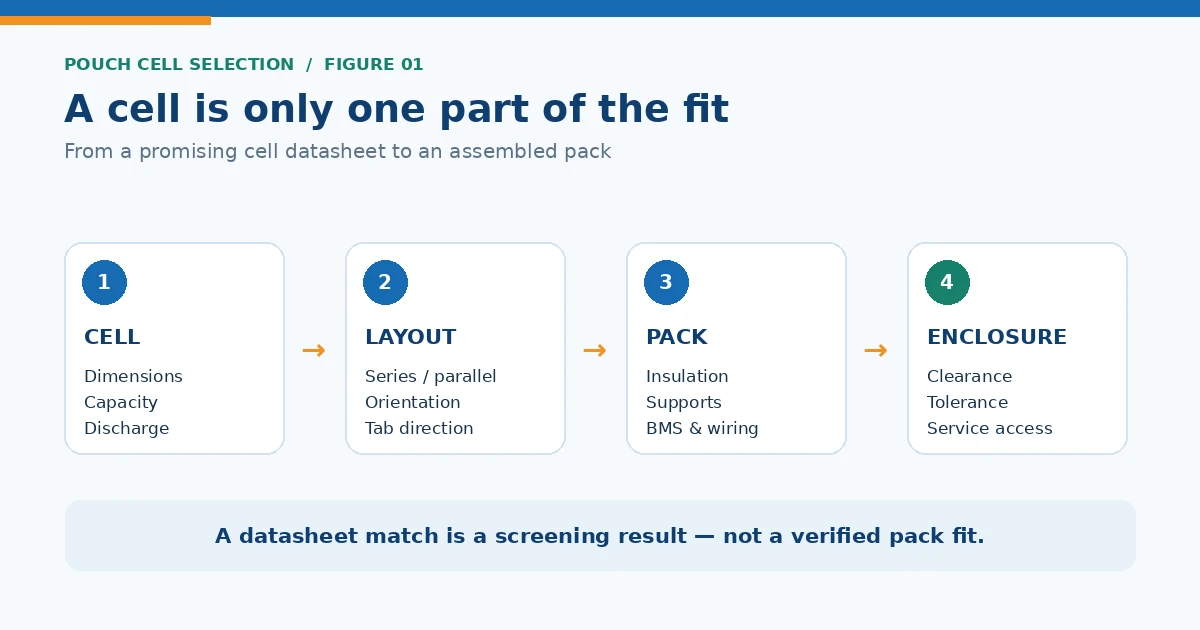
A pouch cell can appear to meet a project’s capacity, voltage, and discharge targets—and still leave too little room for a safe, buildable battery pack. The reason is simple: a cell datasheet describes one component. A finished pack must also accommodate cell tolerances, tabs, insulation, supports, busbars, a BMS, wiring, and assembly clearance.
Quick answer: Treat cell dimensions as an initial screening check. Confirm the complete stack-up in all three axes, then verify the design with a representative sample or prototype before calling the pack fit confirmed.
An anonymized pouch cell selection evaluation
In one ongoing engineering inquiry, the project team was looking for a high-energy pouch-cell solution for a tightly constrained enclosure. The brief combined several goals: a target pack energy, strong continuous discharge, short-duration peak output, and a fixed outer envelope. The team compared several cell formats and series configurations instead of choosing by capacity alone.
Some candidates looked attractive on paper. A thinner custom-format cell could potentially use the available volume efficiently, but its sourcing conditions made small-scale evaluation difficult. A more accessible alternative was easier to sample, yet its thickness and capacity trade-offs needed further review. Another high-power candidate appeared promising electrically, but tab length and orientation still had to be checked against the enclosure.
The project had not reached a confirmed pack design or completed fit test when this article was prepared. Identifying details and selected dimensions are omitted or generalized. This is an evaluation example, not a report of a completed sale or a validated final solution.
Why a cell that fits can still leave an unbuildable pack
1. The cell body is not the whole cell envelope
Pouch-cell drawings may distinguish the body from the overall length including tabs. Tabs need space to bend, connect, and remain electrically isolated. Their direction can change the usable layout even when the cell body fits. Confirm which dimensions the drawing includes, the tab position, and any keep-out area required for the connection.
2. A stack of cells is not a finished stack
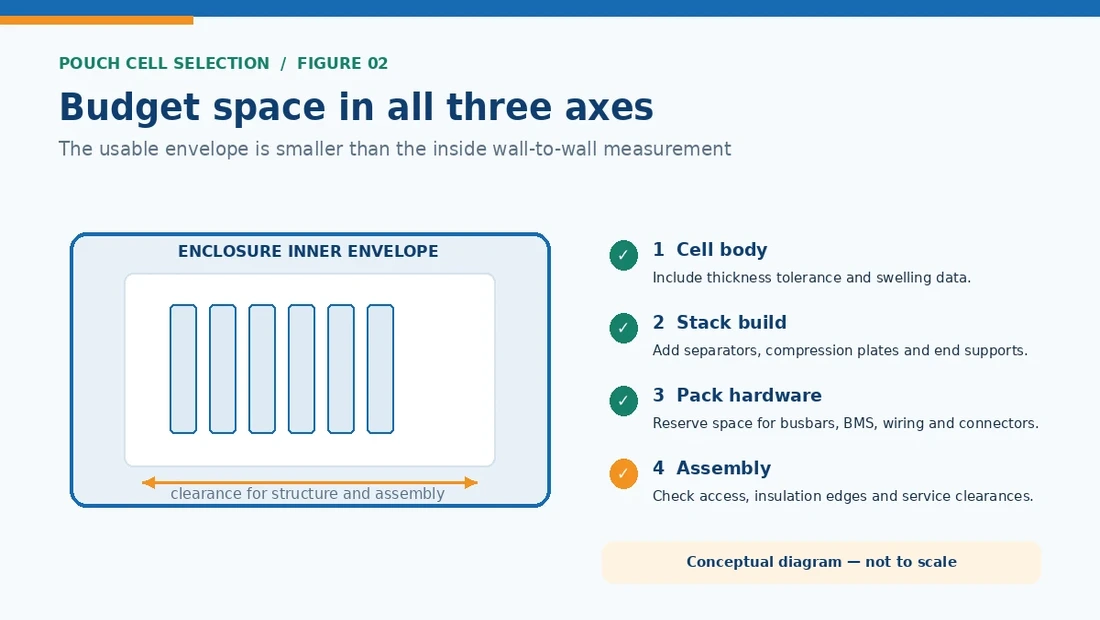
A first-pass estimate often multiplies cell thickness by the number of cells in the stack. That is useful for screening, but it is not the pack thickness. The design may also need separators or insulation, compression plates, end supports, busbars, a BMS, wiring, and manufacturing tolerance. The exact build depends on cell construction and pack architecture.
Screening calculation: bare-cell stack thickness ≈ cell thickness × number of cells in that stack. Then add the components and clearances required by the actual design. Do not treat the bare-cell result as a verified pack dimension.
3. The available space is smaller than the enclosure interior
Mounting features, enclosure walls, seals, cooling paths, cable routing, and assembly access can all reduce usable volume. If a cell dimension is close to an enclosure limit, even a small tolerance or insulation layer can become decisive. Check usable dimensions at the actual mounting plane, not only the nominal internal length, width, and depth.
4. Thickness can change during service
For a pouch-cell pack, the mechanical design should account for thickness tolerance and any cell-thickness change specified or measured over the intended operating conditions. Ask the cell supplier what data is available, what test conditions it represents, and whether the pack needs a defined compression strategy. Do not assume a single nominal thickness describes every cell at every state of charge and age.
Capacity, discharge, and fit must be assessed together
A candidate cell can score well on one requirement and force a compromise elsewhere. Increasing cell thickness may reduce the number of cells that fit in a stack. Choosing a thinner format may change capacity, current capability, availability, or minimum order quantity. Changing the series or parallel arrangement can affect voltage, current, energy, and physical layout at the same time.
For that reason, compare candidates against the real duty cycle, not only a headline C-rate. Confirm whether a current figure is continuous or pulse-rated, how long a pulse lasts, and the test temperature and state of charge. Cell-level ratings also do not automatically establish the continuous current or thermal performance of the completed pack.
The practical question is not “Which cell has the highest capacity?” It is “Which cell and pack arrangement can meet the electrical targets while leaving a buildable mechanical and thermal design?” A candidate should remain provisional until these checks agree.
A particularly important warning sign is a candidate whose footprint nearly uses the available space in one direction. Nominally fitting inside an opening does not leave room automatically for edge insulation, positioning tolerance, or assembly. Review both a plan view and a cross-section, and make sure the drawing shows the cell body, tabs, connection path, supports, and service access. If any of these elements are still assumptions, label the result as a preliminary fit check rather than a confirmed design.
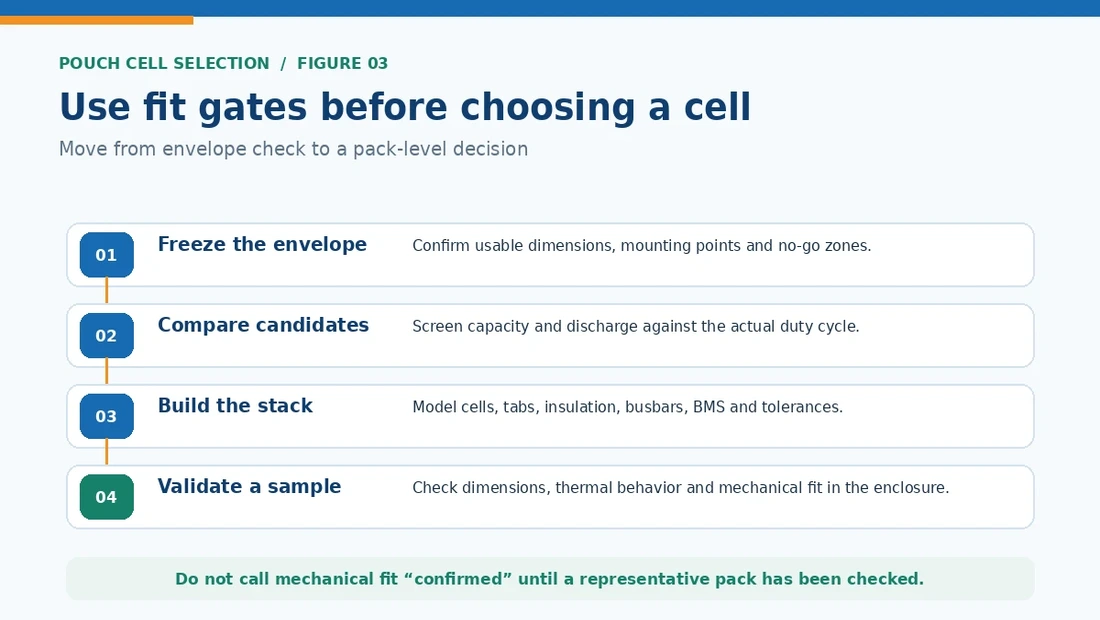
A four-step pouch cell fit check
Freeze the usable envelope. Record internal dimensions at the mounting plane, no-go zones, mounting points, connector access, and the tolerances that affect the battery.
Screen cell candidates. Compare body and overall dimensions, tab layout, thickness tolerance, capacity, and discharge data. Flag unavailable or custom-only formats early.
Build a complete stack-up. Add insulation, separators, supports, compression parts, busbars, BMS, wiring, and assembly clearances to the cell arrangement.
Validate with a representative sample. Check the real cell dimensions and tab orientation, then verify mechanical fit and the relevant thermal and electrical behavior in the intended configuration.
Keep a record of assumptions. Mark which values come from the cell datasheet, which come from the enclosure drawing, and which are estimates. This makes it easier to spot an apparent fit that depends on an unverified dimension.
What this evaluation teaches battery designers
The main lesson is that cell selection and pack design are linked. A pouch cell can meet the electrical brief and still be a poor fit for the intended stack. A cell that appears to fit by its nominal body dimensions may leave insufficient room for tabs, insulation, tolerances, and assembly. And a mechanically attractive option may not be available in a practical quantity.
When evaluating a lithium ion pouch cell or comparing pouch cells for an OEM project, share the usable enclosure drawing, target voltage and energy, continuous and peak current profile, temperature range, expected quantity, and sample timeline. Those inputs help narrow the options before detailed pack engineering begins.
Frequently asked questions
Does a pouch cell that fits inside the enclosure mean the battery pack will fit?
No. The pack also needs space for electrical connections, insulation, supports, the BMS, wiring, tolerances, and assembly. Confirm the complete pack stack-up.
How do I estimate pouch-cell stack thickness?
Multiply the specified cell thickness by the number of cells in that stack for a bare-cell estimate. Then add the real mechanical and electrical components, tolerances, and required clearances. Verify the assumptions with the cell supplier and pack designer.
What should I ask about pouch-cell thickness?
Ask for the thickness tolerance, the measurement method, available data on thickness change under relevant operating conditions, and any recommended compression or support requirements.
Can a cell’s discharge rating confirm the pack’s current capability?
No. A cell rating depends on specified test conditions. Pack current capability also depends on cell configuration, busbars, connections, cooling, BMS limits, and the application duty cycle.
Need help screening pouch cell options?
MisenPower supplies pouch-cell options for projects with different capacity, voltage, and discharge requirements. Explore our pouch cell range or review a representative pouch cell product page. For a project review, provide the enclosure drawing and operating profile so candidate cells can be screened against both electrical and mechanical requirements.
Case note: This anonymized example describes an ongoing technical evaluation. It does not claim that a final cell selection, sale, prototype fit, or performance validation has been completed.